CATEGORIES
TAGS
Choosing podcast niches: find and validate profitable topics

TL;DR:
- Choose a niche based on your passion, expertise, and unique audience perspective.
- Validate demand using tools like Google Trends, Reddit, and listener reviews before launching.
- Focus on authentic engagement and listener insights rather than overanalyzing to discover your best niche.
You’ve got the gear, the ideas, and the drive to build something real. But the moment you sit down to pick your podcast niche, it all gets blurry. Should you go broad or laser-focused? Personal or professional? Trendy or timeless? The truth is, most creators stall here not because they lack ideas, but because they don’t have a clear system for choosing and validating the right one. This guide walks you through exactly that: how to find a niche that fits your strengths, confirm there’s real audience demand, and set yourself up to monetize through product trends and listener insights.
Table of Contents
- Clarify your ‘why,’ expertise, and unique angle
- Research market demand and trending discussions
- Validate your podcast niche using proven frameworks
- Monetization strategies for focused podcast niches
- Why most podcasters overcomplicate niche discovery (and what actually works)
- Discover, analyze, and launch your podcast niche with Prodcast
- Frequently asked questions
Key Takeaways
| Point | Details |
|---|---|
| Align expertise with demand | The most successful podcast niches connect your passion and skills with real listener needs. |
| Validate with real data | Use platforms and listener insights to confirm there’s an audience for your chosen niche before launching. |
| Frameworks for focus | Apply models like IDEA and the six filters to stress-test and refine your podcast concept. |
| Monetize intentionally | Niche podcasts can earn more through targeted sponsors and by leveraging listener-driven product recommendations. |
Clarify your ‘why,’ expertise, and unique angle
Now that you know why picking the right niche is crucial, let’s start with the most important foundation: understanding your purpose and edge as a host.
Start with the honest question: Why do you actually want to host this show? Not the polished answer you’d give at a podcasting conference, but the real one. Passion isn’t just a nice-to-have. It’s the fuel that keeps you recording when the download numbers are still small and the grind feels real. If you’re not genuinely curious about your topic, listeners will feel it.
Once you’ve locked in your passion, layer in your expertise. What do you know that most people don’t? What have you lived through, built, or studied that gives your voice authority? This doesn’t mean you need a PhD. It means you bring something to the table that earns trust. Choosing a podcast topic that sits at the crossroads of what you love and what you know is where the magic happens.
From there, think about your unique angle. This is where a lot of hosts skip a step. Two podcasts can cover the same subject but feel completely different based on perspective, format, and framing. The Venn diagram approach maps where your skills, passions, and audience demand all overlap. That intersection is your niche sweet spot.
Here’s a quick self-assessment checklist to run through before you commit:
- Could you record 100 episodes on this topic? If the answer is hesitant, dig deeper.
- Do you have firsthand experience or insider access? Both build credibility fast.
- Are existing podcasts in this space leaving gaps? Look for recurring listener complaints in reviews.
- Would your target audience already trust you? Shared background or language goes a long way.
- Is this topic trending, evergreen, or both? Evergreen content with trending angles is the sweet spot.
Pro Tip: Search Apple Podcasts or Spotify for your niche idea and read the one-star reviews of top shows. Those reviews are basically a free content brief. Listeners tell you exactly what’s missing.
“The best podcast ideas don’t come from brainstorming sessions. They come from noticing what you already can’t stop talking about.”
Gap-spotting is one of the most underused tactics in niche selection. If every show in your space takes the same interview format, try solo deep dives. If every host talks theory, bring real case studies. Your differentiation is often just a format shift away.
Research market demand and trending discussions
With a clearer sense of what you offer, the next step is to validate there’s actual demand for your ideas.
You can love a topic deeply and still find that not enough people are searching for it. That’s not a reason to abandon ship. It’s a signal to refine your angle. Niches validated through passion and demand consistently outperform shows built on either alone.
Start your research with Google Trends. Type in your niche keyword and look at the trajectory over 12 to 24 months. Is it growing, flat, or declining? Cross-reference with Reddit. Subreddits in your niche are gold mines. Notice which posts get hundreds of comments, which products come up repeatedly, and which questions never seem to get a clean answer. Those are your content pillars.
Podcast search engines like Listen Notes let you gauge how crowded a space is. If there are 10,000 shows on a topic, that’s not automatically bad. It means there’s proven demand. The real question is whether the top shows are serving the audience well. Use podcast content analytics tools to spot what products, brands, and topics surface most in listener conversations across shows in your space.

| Tool | Use case | Free/Paid |
|---|---|---|
| Google Trends | Keyword and topic trajectory | Free |
| Community demand and pain points | Free | |
| Listen Notes | Podcast market sizing | Free/Paid |
| Prodcast | Product mentions and listener trends | Paid |
| SparkToro | Audience behavior and interests | Paid |
Watch out for these red flags when sizing up a niche:
- Listener reviews that are consistently lukewarm across all shows
- Topics driven purely by a single viral moment with no sustained discussion
- Niches where the top 3 shows dominate 90% of listener attention
- Low presence in Reddit, Facebook groups, or industry newsletters
- No clear product or service ecosystem around the topic
Pro Tip: B2B and professional-focused niches consistently pull higher CPMs than general consumer topics. If your niche serves marketers, founders, or specialists in any field, your improving podcast discoverability efforts will also attract brand partners willing to pay premium rates for targeted reach.
Validate your podcast niche using proven frameworks
Uncovering interest is vital, but next you need to stress-test your idea with frameworks that reveal staying power and audience appeal.
Two frameworks do a lot of the heavy lifting here: IDEA and the Six Filters. They sound formal, but they’re actually pretty practical once you run your niche through them.
IDEA breaks down like this:
- Impact: Does your podcast solve a real problem or create a meaningful shift for listeners?
- Depth: Is there enough substance to go 50 or 100 episodes deep without repeating yourself?
- Engagement: Will listeners feel compelled to share episodes, leave reviews, or join a community?
- Authenticity: Does the topic genuinely align with who you are, not just what’s trending?
The IDEA and six filters validation approach gives you a structured way to stress-test an idea before you invest months into it.
The Six Filters ask you to confirm:
- Can you describe your specific listener in one sentence?
- Is this topic sustainable for at least two years of consistent content?
- Is there room in the market, even if competition exists?
- Does this topic create a sense of belonging or identity for your audience?
- Does your natural communication style fit the format this topic demands?
- Do you know exactly where your ideal listener already spends time online?
Here’s how the two frameworks compare:
| Framework | Strengths | Best use case | Limitations |
|---|---|---|---|
| IDEA | Evaluates creator fit and long-term depth | Early ideation stage | Doesn’t measure market size |
| Six Filters | Tests audience clarity and competitive room | Pre-launch validation | Requires market research first |
A practical step-by-step to run both:
- Write your niche idea in one sentence.
- Score it 1 to 5 on each IDEA criterion.
- Answer each of the Six Filter questions with a yes or no.
- If you score under 15 on IDEA or get three or more no’s on the filters, refine before launching.
- Test your refined idea with a short survey or a social media post targeting your intended audience.
For growing a podcast audience from scratch, this kind of pre-launch validation saves months of guesswork and dramatically improves your chances of building a show people actually come back to.
Monetization strategies for focused podcast niches
Once your niche is validated, it’s time to think about how you’ll turn your engaged audience into a sustainable revenue stream.
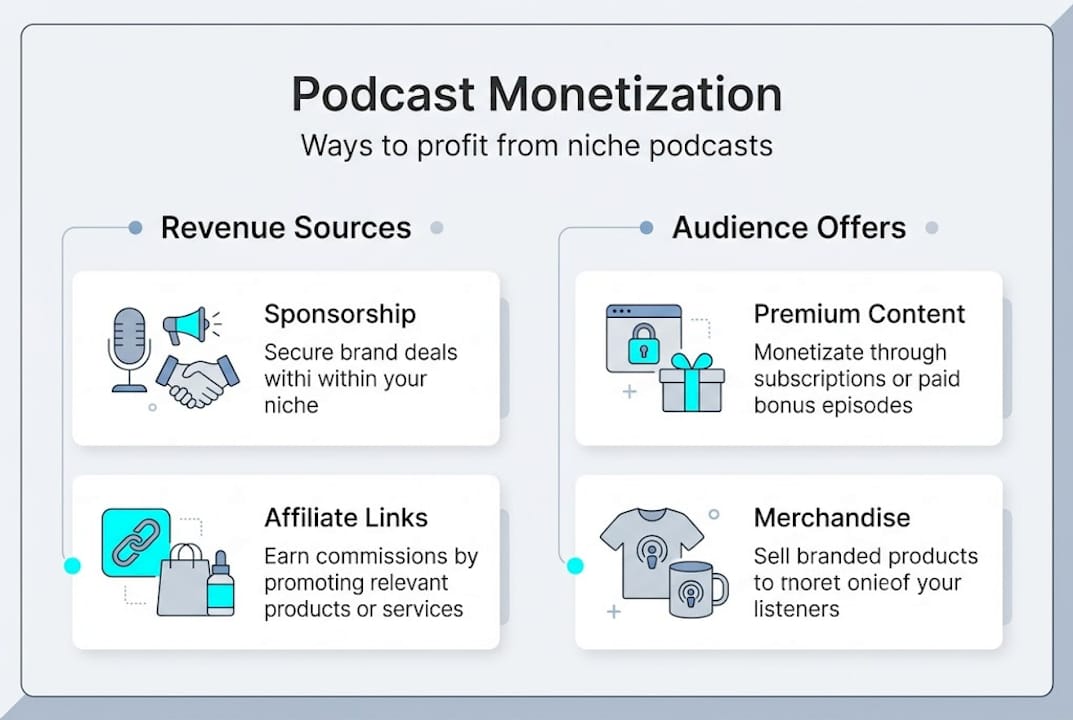
Niche shows actually have a monetization advantage over broad ones. Advertisers pay more to reach a specific, defined audience. Your listeners trust your recommendations because you’re not trying to speak to everyone. That trust is worth real money.
Here are the top three monetization models for niche podcasts:
- Sponsorships and host-read ads: Brands in your niche pay to be featured in your episodes. B2B professional niches command CPMs of $50 or higher, compared to $15 to $25 for general consumer shows.
- Affiliate partnerships: Recommend products your listeners already want. If your episodes mention tools, books, or services regularly, affiliate links turn those mentions into commissions. This works especially well when you monetize your podcast by tracking which product mentions drive the most listener action.
- Premium content and community: Patreon tiers, private episodes, or listener communities give your most loyal fans a way to go deeper with you, and pay for the privilege.
Trending product recommendations are an underused revenue channel. When listeners hear you mention a supplement, a productivity app, or a business book on multiple episodes, they’re primed to buy. That repetition signals trust.
Pro Tip: Before pitching sponsors, compile a short document of actual listener language. Pull quotes from reviews, DMs, or community posts that describe the product problems your audience faces. Sponsors respond to specificity. A pitch that says “our listeners struggle with X and use your product to solve it” closes faster than a generic media kit.
Here’s a quick sponsor pitch structure you can adapt:
“We serve [specific listener type] who care deeply about [niche topic]. Our audience has mentioned [relevant product category] as a recurring need, and we’d love to explore a partnership that puts [brand] in front of them authentically.”
That’s it. Short, specific, and grounded in real listener behavior.
Why most podcasters overcomplicate niche discovery (and what actually works)
With the playbook in hand, it’s worth considering a different angle that experienced creators swear by.
Frameworks are useful. Spreadsheets have their place. But the creators who actually build loyal audiences tend to share one habit: they listen more than they analyze. The real niche discovery often happens in the comments section, in a reply to a newsletter, or in a voice message from a listener. That’s where the good stuff lives.
Analysis paralysis is real. Spending three months researching a niche is often just a sophisticated form of procrastination. The creators who win pick an angle that feels right, record five to ten episodes, and then listen to their audience to refine from there.
Driving podcast product discovery from real listener discussions is more powerful than any keyword tool. The conversations already happening in your niche are pointing directly at the content gaps and product opportunities you should be building around.
“Your best niche is hiding in plain sight, where your passion meets your listeners’ next big questions.”
Simplicity wins. Start. Adjust. Repeat.
Discover, analyze, and launch your podcast niche with Prodcast
Ready to put these insights to work? Prodcast streamlines everything from idea discovery to content analysis.
Prodcast is built for exactly this moment. It scans podcast transcripts across thousands of shows to surface which products, brands, tools, and topics are trending in real listener conversations. You don’t have to guess what your audience wants. The data is already in the audio.

Use Prodcast to discover podcast moments where specific products or topics spike in discussion, then build your niche strategy around what’s already gaining traction. Whether you’re validating a new show idea or finding your first sponsor pitch angle, the platform turns hours of research into a clear, actionable picture. Launch your podcast niche with confidence backed by real data, not guesswork.
Frequently asked questions
What is the IDEA framework for podcast niche validation?
The IDEA framework stands for Impact, Depth, Engagement, and Authenticity, four criteria designed to help you evaluate whether your podcast concept is both compelling for listeners and sustainable for you as a creator.
How do I know if a podcast niche is profitable?
A niche is likely profitable when it shows steady listener growth, consistent community engagement, and clear demand for products or services your audience already buys. B2B and professional niches in particular tend to attract higher-value sponsorships.
What tools can help me analyze trending podcast topics?
Google Trends, Reddit, Listen Notes, and Prodcast’s content discovery features are all solid starting points for spotting which topics and tools for podcast validation are gaining momentum across active listener communities.
Should I focus on B2B or consumer niches for monetization?
B2B and professional audiences consistently deliver higher sponsorship CPMs and open doors to service-based partnerships, making them a strong choice if your expertise and content naturally fit that space.