CATEGORIES
TAGS
Enhancing Podcast Engagement: Strategies That Work

TL;DR:
- Building deep understanding of your listeners allows for targeted engagement strategies that foster genuine connection. Incorporating listener questions, thematic continuity, and varied formats encourages active participation and binge listening. Consistent publishing and personalized CTAs, supported by proper metrics, are essential for sustainable long-term engagement growth.
You’re publishing consistently, your download numbers are climbing, and yet something feels off. The comments are quiet. Nobody’s replying to your episodes. Enhancing podcast engagement isn’t just about getting more ears on your show. It’s about turning those listeners into people who actually care, who share clips with friends, who email you their thoughts, and who show up week after week because they feel genuinely connected to what you’re building. Downloads are a vanity metric. Engagement is the real signal. Here’s how to build it deliberately.
Table of Contents
- Key takeaways
- Enhancing podcast engagement starts with knowing your listener
- Content tactics that make listeners actually interact
- Building community and amplifying reach
- Measuring what actually matters
- My honest take on what actually builds engagement
- How Prodcastapp helps you turn moments into engagement
- FAQ
Key takeaways
| Point | Details |
|---|---|
| Know your listener deeply | Build detailed listener personas before designing engagement tactics to make every segment land. |
| Interactive content retains | Incorporating Q&A segments and listener questions can raise retention by 73%. |
| Email beats social | Podcast newsletters achieve 35 to 45% open rates, far outperforming typical social media reach. |
| Track consumption rate | A 60% or higher consumption rate signals your content is genuinely resonating with your audience. |
| Engagement compounds | Consistent, community-focused effort builds a self-reinforcing cycle of loyalty and organic growth over time. |
Enhancing podcast engagement starts with knowing your listener
Most podcasters skip this step entirely. They launch, post on social media, hope for the best, and then wonder why nobody’s sticking around. Real podcast engagement strategies begin with understanding who is actually listening and what they genuinely want from your show.
Start by building a listener persona. Not just “35-year-old marketing professional.” Go deeper. What shows do they already listen to? When do they tune in, during their commute, at the gym, while cooking? What problems are they trying to solve? The more specific your persona, the easier it becomes to create content that makes someone pause mid-run and reach for their phone to leave a review.
Use surveys early and often. A simple Google Form dropped in your show notes or Instagram Stories can surface listener motivations you would never have guessed. Ask what topics they want more of, what format they prefer, and what made them subscribe in the first place. This doubles as a trust signal. Listeners who are asked for their input feel like partners, not just passengers.
On the discoverability side, SEO-optimized transcripts are one of the most underused tools in podcasting. Publishing full transcripts with keyword-rich show notes pulls in search traffic from people who have never heard your name. Once they land on your content, you have a chance to convert them into loyal listeners. Internal links between related episodes also create topical authority that keeps both search engines and listeners moving through your archive.
Here’s a quick look at the tools worth having in your preparation toolkit:
| Tool type | Purpose | Example use |
|---|---|---|
| Listener survey | Gather pre-launch and ongoing feedback | Google Forms, Typeform |
| Analytics platform | Track drop-off and consumption rates | Spotify for Podcasters, Chartable |
| SEO and transcript tool | Improve discoverability via search | Descript, Otter.ai |
| Community platform | Host listener conversations | Discord, Circle |
| Email marketing tool | Nurture subscribers directly | ConvertKit, Beehiiv |
Content tactics that make listeners actually interact
This is where most podcast engagement strategies either shine or fall flat. Good content isn’t just well-produced. It actively pulls listeners into a conversation rather than broadcasting at them from a distance. The shift from broadcasting to building is the single most important mindset change a podcaster can make.
One of the highest-leverage tactics is incorporating listener questions directly into episodes. Read the question out loud, credit the listener by name, and give a thoughtful answer. This does several things at once. It rewards the person who submitted the question, signals to every other listener that their voice matters, and creates a feedback loop that fills your content calendar almost automatically.

Thematic continuity is another underrated approach. Try using “relay questions” between guests, where you ask one guest a question and then pose their answer to the next guest the following week. This creates episode-to-episode continuity that encourages binge listening. Listeners who feel like they are following a thread stay subscribed longer.
Format variety matters more than most podcasters realize. A few formats worth rotating in:
- Live episodes with real-time audience Q&A create urgency and exclusivity
- Listener story segments where you feature short audio clips or read-outs from the community
- Poll-based episodes where the audience votes on what topic gets covered next
- Debate format where two guests argue opposite sides of a question your audience submitted
On the production side, high-quality audio cuts listener drop-off by 40% compared to shows recorded on built-in laptop microphones. That stat should make every podcaster go check their gear setup today.
And then there are CTAs. Most podcasters say something like “leave us a review if you enjoyed this episode.” That’s not a bad CTA, it’s just a weak one. Effective CTAs are contextually tied to episode content, not generic requests. If your episode just covered how listeners can negotiate their salary, your CTA could be: “If you are going into a salary conversation this month, send me an email after and tell me how it goes.” That’s specific, timely, and creates genuine interaction.
Pro Tip: Write your CTA during the episode outline phase, not as an afterthought at the end of recording. When the CTA grows naturally from the episode content, it feels like a conversation and not a commercial.
Building community and amplifying reach
Creating good content is only half the equation. Getting that content in front of more people, and making those people feel like part of something, is the other half. Enhance podcast community involvement and you stop relying entirely on algorithm-driven discovery.
The most durable communities form around a shared identity. 52% of listeners say they view the podcasts they follow as reflections of their own values. That’s not a small number. It means your show is not just entertainment. For a significant chunk of your audience, it is a piece of how they see themselves. Build your community content around that identity and you create something people feel loyal to rather than just subscribed to.
Here is how different platforms and tactics stack up for building that community:
| Tactic | Platform | Engagement impact |
|---|---|---|
| Email newsletter | ConvertKit, Beehiiv | Very high (35 to 45% open rates) |
| Listener Discord or Circle | Discord, Circle | High, especially for niche shows |
| Guest share kits | Social media, email | Double reach via guest promotion |
| Audiograms and clips | Instagram, TikTok, LinkedIn | Medium, great for cold discovery |
| Cross-promotion | Partner podcasts | High quality, pre-warmed audience |
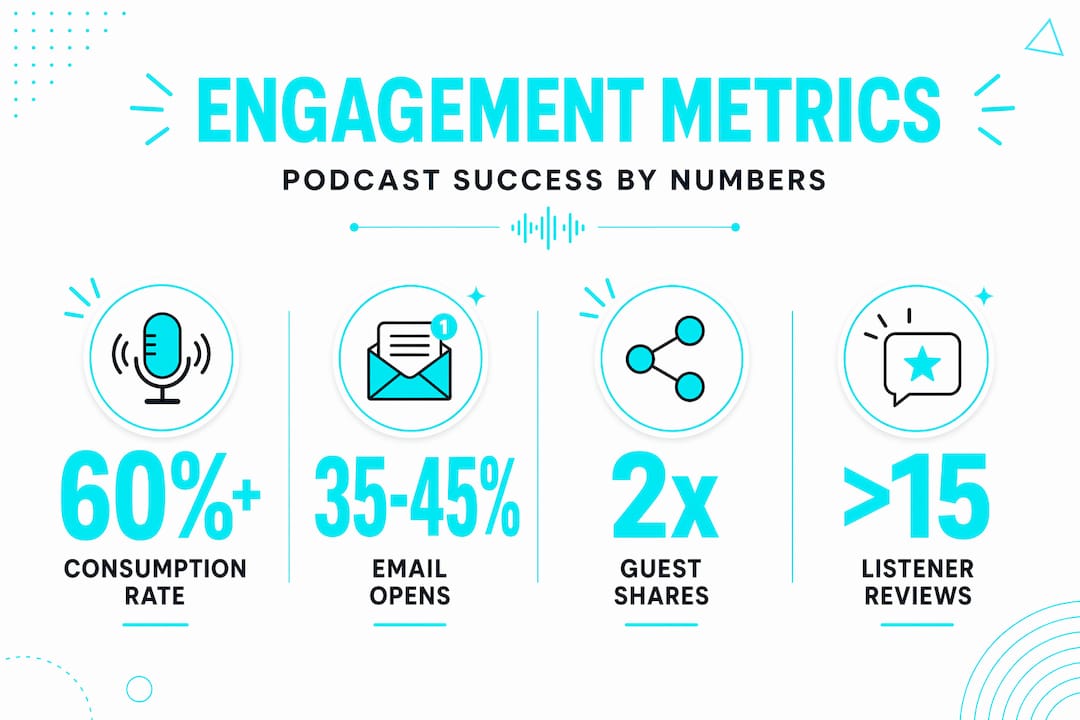
Email newsletters deserve a special call-out here. Podcast email newsletters hit 35 to 45% open rates on average, while organic social media reach typically lands between 3 and 5%. If you are spending more energy on Instagram than on your subscriber list, you are working against yourself.
Guest share kits are another practical tactic that often gets overlooked. When you equip guests with pre-made audiograms, suggested captions, and episode links, episode reach can double because guests share with their own audiences. You get a warm introduction to listeners who already trust your guest. That is a very different person from someone who clicks a cold ad.
For growing your community across platforms, the key is real-time interaction. Go live occasionally. Reply to every comment in your first year. Show up in your Discord. The listeners who see you engaging with the community become your loudest promoters.
Measuring what actually matters
You can have all the right podcast engagement strategies in place and still spin your wheels if you’re not tracking the right things. Downloads tell you how many people hit play. Engagement metrics tell you what happened next.
The numbers worth watching closely:
- Consumption rate: Aim for 60% or higher. Below that threshold, your content may be losing listeners before they reach your CTA or key moments.
- Email open rate: A direct signal of how invested your subscriber list is in your content.
- Review velocity: The rate at which new reviews arrive. A sudden spike often correlates with a particularly strong episode or CTA.
- Social shares: Track which episode clips and quotes get shared organically. Those are your best content signals.
- Listener feedback volume: How many emails, DMs, or voice messages you receive per episode.
Analytics tools like Spotify for Podcasters show you drop-off curves, which reveal exactly where listeners check out. If 40% of your audience leaves at the 12-minute mark every episode, something is consistently happening at that point. Maybe it is a long sponsor read. Maybe the energy dips. Either way, you now have specific data to act on rather than vague instinct.
Engagement also compounds over time when you treat your show as a digital storefront with SEO-optimized assets. Each well-titled episode, each transcript, each internal link between related shows adds to a growing body of searchable, discoverable content.
Pro Tip: Set one specific engagement goal per quarter rather than trying to move every metric at once. “Grow my email list by 200 subscribers this quarter” is a goal you can build a strategy around. “Increase engagement” is not.
My honest take on what actually builds engagement
I’ve seen podcasters obsess over download counts while their most loyal listeners quietly stop showing up. I’ve also seen shows with modest numbers build communities so engaged that sponsors fight to get in front of them.
Here’s what I’ve learned. Engagement is a compounding cycle, not a single campaign. The podcasters who win long-term are the ones who think about every episode as a deposit into a relationship, not a content deliverable to check off. Every listener question you answer on-air, every time you remember a listener’s name, every “relay question” you pass between guests adds to a growing sense that this show is alive and paying attention.
I’ve also watched creators chase vanity metrics and burn out. The answer is not to try every tactic at once. Pick two or three podcast listener engagement strategies that fit your personality and your format, then go deep on them. Surgical CTAs and a weekly newsletter will do more for long-term retention than posting audiograms on every platform simultaneously.
The uncomfortable truth is that weekly publishing matters more than most creators want to admit. Shows that publish consistently grow 40% faster than those that publish sporadically. Consistency is not just about the algorithm. It is about showing your listeners that you respect their time enough to show up reliably. That respect, compounded over months, is what turns a subscriber into an advocate.
— Jason
How Prodcastapp helps you turn moments into engagement

Here’s where things get interesting for podcasters who want data on their side. Prodcastapp is built to help you find the clips, quotes, and product mentions inside your episodes that are most likely to make someone stop scrolling and actually listen. Instead of manually scrubbing through recordings to find your best moments, Prodcastapp’s AI surfaces them for you. Check out Prodcast Moments to see how it turns your episodes into a shareable highlight reel that does the heavy lifting of audience discovery for you.
For podcasters focused on meaningful listener engagement, Prodcastapp also tracks which topics, products, and expert recommendations are trending across thousands of shows. That means you can create content around what audiences are genuinely responding to right now, not what worked six months ago. It’s the kind of edge that makes your next episode feel timely rather than generic.
FAQ
What is the best way to start enhancing podcast engagement?
Begin by building a detailed listener persona and gathering direct feedback through surveys. Knowing exactly who you are talking to is the foundation that makes every other engagement tactic more effective.
How often should I publish to improve listener engagement?
Weekly publishing builds listener habits and grows audiences 40% faster than irregular schedules. Consistency signals reliability, which deepens listener trust over time.
What metrics show that my podcast engagement strategies are working?
Track your consumption rate, aiming for 60% or above, alongside email open rates, review velocity, and listener feedback volume. These give you a clearer picture of engagement than downloads alone.
How can I use guests to increase listener engagement?
Provide guests with pre-made share kits including audiograms and suggested captions. This simple step can double your episode reach by activating each guest’s existing audience on your behalf.
Why do CTAs matter for podcast listener engagement?
Generic CTAs produce generic results. CTAs that are tied directly to the episode’s topic feel like a natural next step rather than a request, which dramatically increases the likelihood that listeners will act on them.