CATEGORIES
TAGS
How podcast content moderation drives brand safety

TL;DR:
- Podcast content moderation is increasingly essential as AI tools detect violations and protect brands from controversy and platform removal risks.
- Effective moderation involves a hybrid approach using speech-to-text transcription, contextual analysis, severity scoring, and human review to ensure fairness and accuracy; understanding its limitations helps creators avoid wrongful takedowns and build trust.
Most creators still think of podcast content moderation as someone else’s problem. It’s audio, right? You record, you publish, you grow. But the ground has shifted fast. A single flagged episode can trigger a chain reaction that pulls distribution, kills sponsor deals, and damages a brand that took years to build. And the risks aren’t always obvious until something goes very wrong. AI-driven moderation for podcasts now uses speech-to-text transcription, contextual analysis, and severity scoring to detect violations at the episode level, which means platforms are catching content they never could before.
Table of Contents
- Why podcast content moderation matters now
- How podcast content moderation actually works
- Edge cases and moderation pitfalls: What can go wrong?
- Best practices for effective and fair podcast moderation
- The nuance of audio: Why perfect moderation isn’t possible (and why that’s okay)
- Take your podcast further with smarter content moderation tools
- Frequently asked questions
Key Takeaways
| Point | Details |
|---|---|
| AI and human collaboration | Hybrid workflows balance scale with nuanced, fair podcast content moderation. |
| Brand safety importance | Proper moderation protects creator reputations and keeps marketing partnerships viable. |
| Common moderation pitfalls | False positives, wrongful takedowns, and dialect issues are real risks that creators must anticipate. |
| Best practices matter | Diverse data, clear policies, and appeals help maintain credibility and listener trust. |
Why podcast content moderation matters now
With the moderation landscape rapidly shifting, it’s worth asking why safeguarding podcast content is becoming non-negotiable. The short answer? The stakes have never been higher.
Podcast audiences have exploded in recent years, and with scale comes scrutiny. More listeners means more chances for a heated comment, a careless joke, or a politically charged segment to land badly. When it does, it doesn’t stay in audio form for long. Clips get shared on social media, context disappears, and suddenly a single moment from a long-form episode becomes a headline.
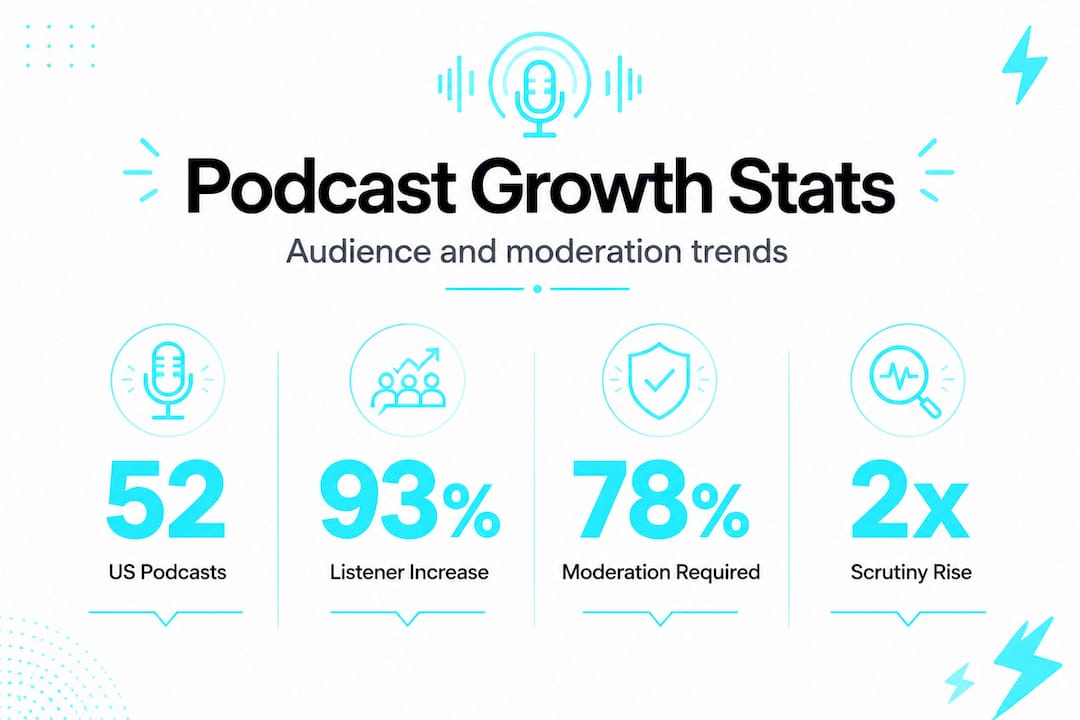
Toxicity in podcasts is a real, measurable problem. An empirical study of 52 US podcasts found clear patterns in how toxicity escalates within conversational chains, especially in political shows. The anchors in toxic chains were longer, more repetitive, and more emotional than regular conversation. This wasn’t just isolated incidents but a systemic pattern in both right-leaning and left-leaning shows.
For brands, this has a direct financial implication. Advertisers are paying close attention to podcast content trends and pulling ad spend from shows that generate controversy. Brand safety tools now flag unsafe content adjacency automatically, which means a show that routinely pushes boundaries may find itself cut off from programmatic ad revenue without warning.
Here’s what’s at stake for unmoderated podcasts:
- Sponsor relationships at risk: A single controversial episode can trigger a clause in most modern podcast ad agreements.
- Platform distribution threats: Apple Podcasts, Spotify, and YouTube all have content policies that can result in episode removal or full show suspension.
- DMCA takedown exposure: Unverified audio clips, including background music or broadcast snippets, can lead to entire episode removals.
- Reputation damage: Once a creator gets labeled “toxic” or “unsafe,” recovering trust with both audiences and sponsors is incredibly hard.
“Brands are no longer willing to wait and see. They’re demanding proactive moderation as a condition of partnership, and that expectation is filtering down from major networks to individual creators.”
The message is clear. Moderation isn’t just a platform-level concern. It’s a creator-level responsibility.
How podcast content moderation actually works
Understanding the “why” sets the stage for digging into the mechanics of how moderation unfolds for every podcast episode.
Most people imagine moderation as a human reviewer sitting with headphones, scrubbing through audio. That used to be true. Now, it’s a layered, largely automated process that happens faster than most creators realize. Here’s a step-by-step breakdown of what happens under the hood.
- Speech-to-text conversion: Every episode gets transcribed automatically using tools like Whisper or similar ASR (automatic speech recognition) models. This converts the audio into searchable, analyzable text.
- Contextual analysis: The transcript is scanned for keywords, phrases, and patterns associated with hate speech, threats, misinformation, or policy violations. This isn’t just word-matching; it includes contextual signals around each flagged term.
- Severity scoring: Each potential violation gets assigned a severity score based on frequency, intensity, and context. High-severity flags may trigger automatic holds; lower scores queue for human review.
- Human review layer: For edge cases, including sarcasm, cultural references, dialect-specific expressions, or borderline content, a human reviewer steps in to make the final call.
- Action and feedback loop: Content is either cleared, edited, removed, or escalated. Patterns from these decisions feed back into the AI model to improve future accuracy.
According to the framework laid out in AI podcast moderation, hybrid human-AI workflows are strongly recommended precisely because AI alone still struggles with nuance. The human-in-the-loop approach is the current gold standard.
Here’s a quick comparison of how major platforms handle podcast moderation:
| Platform | Primary moderation method | Human review available? | Appeals process |
|---|---|---|---|
| Spotify | AI + editorial review | Yes | Limited, case-by-case |
| Apple Podcasts | AI flagging + team review | Yes | Email-based |
| YouTube | AI-first, then human | Yes | Standard appeals system |
| Amazon Music | Policy-based + automated | Limited | Inconsistent |
What’s interesting is that the same transcript data used for moderation can be repurposed for far more useful things. Think about how AI in podcasting is already being used to extract product mentions, identify brand conversations, and surface the moments that make audiences stop and rewind. Moderation and discovery are two sides of the same coin.
Pro Tip: If you’re a creator, request transcript access from your hosting platform. Reading your own transcripts before publishing is one of the most effective ways to catch potential flags before an algorithm does it for you. It also gives you insight into how your content appears to search and discovery tools, which connects directly to podcast curation for product visibility.
Edge cases and moderation pitfalls: What can go wrong?
While AI-powered moderation is robust, its limitations can have real and sometimes severe impacts on content creators and brands.
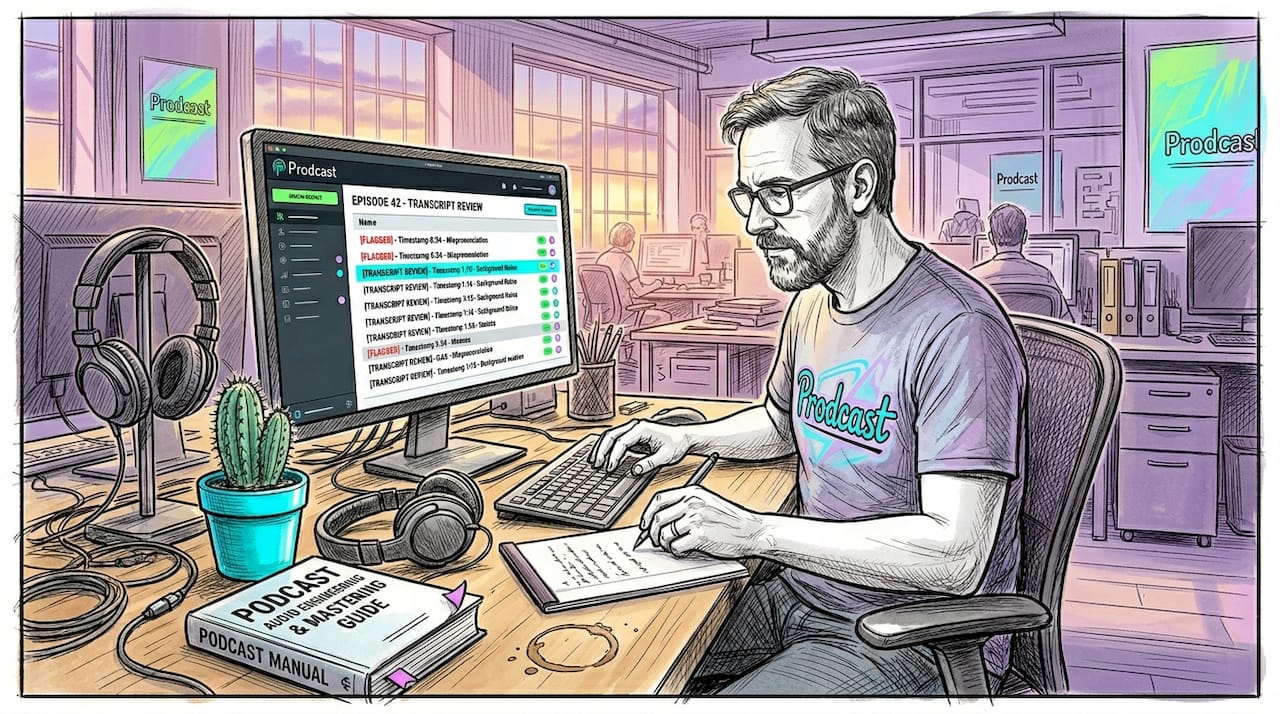
Let’s be honest. No moderation system is perfect, and the failures can feel completely arbitrary when you’re on the receiving end. A creator in Quebec records an episode in French. A regional dialect phrase gets misinterpreted as a violation. The episode gets pulled. The creator has no idea why. Sound far-fetched? It isn’t.
AI false positives in dialect-heavy content are a documented problem, including a reported 37% increase in wrongful takedowns affecting Quebecois French speakers. The algorithm isn’t malicious. It just wasn’t trained on enough diverse language data, and real creators pay the price.
Here’s a breakdown of the most common moderation pitfalls:
- Dialect and slang misreads: Certain regional expressions, slang terms, or community-specific language get flagged because they weren’t in the training data.
- Sarcasm and humor failures: AI has no sense of irony. A darkly comedic segment can read as a serious policy violation if the contextual signals aren’t clear enough.
- Third-party content injection: Some listener apps and third-party integrations can attach images or supplementary content to podcast episodes without the creator’s knowledge. If that injected content is explicit or violates policies, the creator takes the hit.
- DMCA automation errors: Background music, brief broadcast clips, or even ambient sound from a public event can trigger automated copyright strikes that remove full episodes.
- Inconsistent platform policies: What passes on Spotify may get flagged on YouTube. Creators publishing across multiple platforms have to navigate wildly different standards simultaneously.
“When a wrongful takedown hits, it’s not just the episode that disappears. It’s listener trust, search rankings, and in some cases, advertiser confidence — often with no clear explanation from the platform.”
The appeals process varies wildly depending on where you publish. Some platforms give you a structured, responsive system. Others give you a generic form and a 30-day wait. Knowing this in advance, before it happens to you, is genuinely useful. Exploring podcast privacy concerns also helps creators understand how data handling and platform policies interconnect with moderation risk.
A quick comparison of moderation edge cases:
| Scenario | AI gets it right? | Human review helps? | Creator impact |
|---|---|---|---|
| Standard hate speech | Usually yes | Sometimes needed | Minimal if process is clear |
| Regional dialect content | Often no | Yes, essential | High risk of wrongful removal |
| Sarcasm or dark humor | Rarely | Yes, critical | Moderate to high risk |
| Third-party image injection | N/A | Sometimes | Creator wrongly penalized |
| DMCA background audio | Often flagged | Limited ability | Full episode removal risk |
The good news? Most of these risks are manageable with the right preparation and workflow.
Best practices for effective and fair podcast moderation
Learning from pitfalls, you can adopt a set of field-tested strategies to keep podcast content both compliant and welcoming.
Moderation doesn’t have to be a source of anxiety. It can actually become a competitive advantage if you treat it as part of your overall content strategy. Here’s what actually works, based on audio and voice moderation best practices from practitioners in the field.
- Use diverse training data: If you’re building or licensing moderation tools, ensure the underlying datasets include a wide range of dialects, accents, and cultural expressions. Homogenous training data is where bias enters.
- Keep humans in the loop: Don’t automate final decisions on borderline content. A human reviewer who understands cultural context catches things that no AI model will reliably get right.
- Set adaptive thresholds by content type: A true-crime podcast will naturally discuss violent themes. A children’s education podcast operates under entirely different standards. Your moderation thresholds should reflect your content category, not a one-size-fits-all policy.
- Establish a violation hierarchy: Not everything should be treated equally. Create clear tiers: first-time warnings for minor issues, strikes for repeated violations, and bans only for serious, intentional policy breaches.
- Build a transparent appeals process: Make it easy for creators to contest wrongful flags. Document response timelines, assign clear ownership, and communicate outcomes honestly.
- Audit regularly: Run periodic reviews of flagged content and cleared content. Patterns in false positives tell you a lot about where your moderation workflow needs adjustment.
Aligning your content with a data-driven podcast marketing strategy actually makes moderation easier. When your content is structured, intentional, and consistent, there are fewer surprises for both algorithms and human reviewers.
Before publishing any episode, check these boxes:
- Reviewed the transcript for potential flag triggers
- Cleared all background audio rights
- Verified platform-specific content policies for the subject matter
- Set up alerts for automated content actions on your hosting platform
Pro Tip: Create a simple internal checklist for every episode before it goes live. Five minutes of pre-publication review can save days of appeals and re-publishing headaches later on.
The nuance of audio: Why perfect moderation isn’t possible (and why that’s okay)
Here’s an opinion that might make some platform engineers uncomfortable: perfect podcast moderation is not a realistic goal, and chasing it often causes more harm than good.
Every moderation system is built on tradeoffs. You can optimize for speed, but you’ll miss nuance. You can optimize for sensitivity, but you’ll generate more false positives. You can prioritize consistency, but you’ll underserve communities whose language and expression doesn’t fit the dominant training data. These aren’t bugs. They’re inherent structural tensions that no amount of additional compute will fully resolve.
Experts cautioning over-reliance on AI point to something important: AI moderation tools routinely show biases against marginalized voices. A Black creator using African American Vernacular English may face more false positives than a creator using standard American English. A comedian exploring taboo subjects for social critique may have episodes pulled while genuinely harmful content slips through because it’s phrased more carefully.
This isn’t an argument against moderation. It’s an argument for honesty about what moderation can and can’t do. The most effective systems we’ve seen treat moderation as a conversation between platforms, creators, reviewers, and listeners, rather than a top-down enforcement mechanism. Transparency matters enormously. When platforms explain their policies clearly, when creators can see why something was flagged, and when listeners understand how decisions are made, trust builds even when decisions feel imperfect.
What we really need is accountability over perfection. That means publishing clear policies, sharing aggregate data about moderation outcomes, making appeals genuinely accessible, and revisiting decisions when new context emerges. The platforms that surface genuine podcast content insights and treat creators as partners, rather than just sources of flaggable content, are the ones building the most sustainable ecosystems.
The goal isn’t a moderation system that never makes mistakes. The goal is a system that catches the most serious harms, minimizes damage to legitimate creators, and earns trust over time through consistent, transparent behavior.
Take your podcast further with smarter content moderation tools
With a clear understanding of how moderation works and why it matters, now’s the perfect time to see the tools in action.
Prodcast turns podcast transcripts into structured, actionable data. That means you don’t just get insights into what’s being said across thousands of shows. You get the context around those conversations, including when a product gets mentioned, how a brand is being discussed, and which moments are making audiences stop, rewind, and share. It’s the kind of intelligence that makes your content safer, smarter, and more marketable all at once.

Whether you’re a creator looking to stay ahead of moderation risks or a marketer trying to align your brand with the right podcast moments, Prodcast has the tools you need. Explore Podcast Moments to discover the key discussion points driving real engagement, or check out Mass Persuasion to see how leading brands are leveraging podcast analytics for targeted, context-aware promotions. The conversations are already happening. Prodcast helps you hear what really matters.
Frequently asked questions
How does AI detect toxic content in podcasts?
AI moderation tools analyze transcripts using speech-to-text conversion, then apply contextual cues and severity scoring to identify hate speech, threats, and policy violations at the episode level. The process is automated but works best when paired with human review for borderline cases.
What causes wrongful content takedowns in podcasts?
False positives most often stem from AI misreading regional dialects, slang, or culturally specific expressions, along with automated DMCA errors triggered by background audio. These errors can result in entire shows being removed without clear explanation.
Why do experts recommend humans stay involved in podcast moderation?
Human oversight is essential because AI models frequently miss context, show bias against marginalized voices, and can’t reliably interpret sarcasm, humor, or cultural nuance. A human-in-the-loop approach ensures fairer, more accurate outcomes.
What’s the best way to prevent my podcast from being wrongfully flagged?
Best practices include reviewing your transcript before publishing, ensuring diverse training examples if you’re building moderation workflows, and setting up a clear appeals process so wrongful takedowns can be resolved quickly and fairly.