CATEGORIES
TAGS
How podcasts boost brand awareness: proven strategies and ROI
TL;DR:
- Podcast advertising delivers significantly higher brand awareness lift compared to social and display channels.
- Host-read ads have higher conversion rates and authenticity than programmatic spots.
- Continuous, long-term campaigns and leveraging organic mentions maximize effectiveness and awareness.
Podcast advertising is no longer a niche experiment. It’s one of the highest-performing brand awareness channels available to marketers right now. Podcast ads deliver a 45–85% lift in unaided brand awareness, numbers that make most social and display campaigns look modest by comparison. Yet a lot of brands still treat podcasts like a side bet, running a single campaign and hoping for the best. This article breaks down exactly why podcasts outperform, how to choose the right ad format, how to squeeze every drop of value from brand mentions, and how to measure the awareness gains you’re generating.
Table of Contents
- Why podcasts excel at building brand awareness
- Host-read vs programmatic podcast ads: What the numbers show
- Maximizing mention moments for product discovery
- Measuring podcast-driven awareness: Metrics and KPIs
- The data-driven reality: What most marketers miss about podcast awareness
- Leverage podcast moments for your brand with Prodcast
- Frequently asked questions
Key Takeaways
| Point | Details |
|---|---|
| Podcast ads outshine | Podcast campaigns consistently drive greater brand awareness lifts than social media or digital display. |
| Host-read wins trust | Host-read ads deliver triple the conversions of programmatic ads thanks to authenticity and audience rapport. |
| Moments fuel discovery | Trending mentions and spotlights in podcasts create spikes in brand search and purchase intent. |
| Track what matters | Focus on unaided/aided recall and real downstream engagement to measure true podcast ROI. |
Why podcasts excel at building brand awareness
Think about the last time you actually listened to an ad. Not heard it in the background while scrolling. Actually listened, processed, and remembered it. For most people, that happens most often during a podcast. That’s not a coincidence.
Podcast listeners are doing something rare in modern media: they choose to be there. They searched for a show, hit play, and gave it their full attention. That voluntary engagement creates a fundamentally different environment for brand messaging than a pre-roll YouTube ad someone skips in five seconds.
“Podcast audiences are lean-in listeners. They’re not multitasking in the same passive way as TV viewers. They’re exercising, commuting, cooking. Their minds are open and receptive, not defensive.”
That receptive state matters enormously for your brand. When a host mentions your product naturally in conversation, it doesn’t feel like an interruption. It feels like a recommendation from someone the listener already trusts. That’s the trust transfer effect, and it’s one of the most powerful forces in modern marketing.
Here’s what sets podcasts apart from other awareness channels:
- Long attention windows. The average podcast episode runs 30 to 45 minutes. Listeners who stay for the full episode have been in your brand’s orbit for a long time, far longer than a 30-second social video.
- Active content selection. People subscribe to podcasts they genuinely enjoy. That means the audience is pre-qualified and already invested in the host’s perspective.
- Low ad fatigue. Podcast ad loads are typically much lighter than social feeds or streaming video. Fewer ads mean each ad gets more mental real estate.
- Host credibility amplification. When a host reads your ad copy, they’re lending their reputation to your brand. Listeners often can’t distinguish where the content ends and the ad begins, especially with well-crafted host-read spots.
According to podcast effectiveness data, the medium consistently outperforms display, social, and even connected TV for unaided recall. The unaided awareness lift of 45–85% is a benchmark that most marketers don’t believe until they see it in their own campaign results.
The really exciting part? Podcasts work across verticals. Whether you’re selling a B2B SaaS tool to tech founders or a supplement brand to fitness enthusiasts, there’s an engaged niche audience already listening to shows about your exact product category. The medium isn’t just broadly effective, it’s precisely targetable through the right show selection.
That combination of deep engagement, host trust, and niche audience targeting is why podcast advertising continues to grow even as other digital channels face rising costs and declining attention.
Host-read vs programmatic podcast ads: What the numbers show
Once you’re sold on podcasts as a channel, the next question is format. And this is where a lot of marketers get it wrong by defaulting to one approach without testing both.
There are two main formats in podcast advertising: host-read ads and programmatic ads. They work differently, cost differently, and deliver very different outcomes depending on your goals.
Host-read ads are written or briefed by the brand but delivered in the host’s own voice, often with personal anecdotes and genuine endorsement. They feel organic. They’re typically baked into the episode permanently, so they don’t disappear when the campaign ends.
Programmatic ads are pre-produced audio spots placed dynamically across a network of podcasts. They’re inserted at specific points in episodes and can be updated or pulled at any time. Think of them as the podcast equivalent of display advertising.
Here’s how the two formats compare on the metrics that matter most:
| Metric | Host-read ads | Programmatic ads |
|---|---|---|
| Conversion rate | ~1.5% | ~0.5% |
| Cost per acquisition (CPA) | ~$1.67 | ~$2.40 |
| Brand recall | High | Moderate |
| Scale | Limited by show size | High |
| Authenticity | Very high | Lower |
| Campaign flexibility | Low (baked-in) | High (dynamic) |
| Best use case | Trust-dependent conversions | Broad reach and awareness |
Host-read ads yield 3x higher conversion rates than programmatic (1.5% vs 0.5%), and their cost per acquisition comes in at $1.67 compared to $2.40 for programmatic. That’s a meaningful difference if you’re running campaigns at scale.
But programmatic has its place. If you need rapid reach across a large number of shows, or you’re testing creative before committing to a host-read deal, programmatic podcast advertising can be a smart starting point. The key is not treating it as a permanent substitute for host-read placements once you’ve found shows where your audience actually lives.
Contrasting views on both formats confirm that host-read ads are clearly superior for conversions but come at a higher upfront cost, while programmatic scales faster with lower commitment. The practical takeaway? Run both. A/B test your creative across formats, identify which shows and formats drive downstream actions, and then shift budget toward what’s working.
One more thing worth knowing: campaign duration matters a lot. Sustained campaigns running eight weeks or longer consistently show the highest brand lift. Short bursts produce short-term spikes. If you want lasting awareness gains, you need to commit to the medium for a meaningful stretch of time.
Pro Tip: Before signing a host-read deal, ask for the show’s listener demographics and engagement data. A smaller show with a deeply engaged niche audience will often outperform a larger show with broad, passive listenership for direct response goals.
Explore podcast ROI strategies to help guide your budget allocation decisions across formats.
Maximizing mention moments for product discovery
Here’s something most marketers overlook: the organic mention. When a host talks about your product unprompted, or weaves it naturally into a story, that moment carries more weight than almost any paid placement. The listener’s guard is completely down. There’s no disclosure, no scripted pitch. Just genuine enthusiasm.
These moments are gold. And they’re happening constantly across thousands of shows, whether or not you’re tracking them.
Mid-roll host-read ads deliver exceptional trust transfer and high engagement, and repurposing these episode moments across multiple channels multiplies your ROI significantly. That’s the core opportunity in mention moments: capture them, then put them to work across your owned and paid channels.

What happens when your brand gets a prominent mention on a popular show? Typically, you’ll see a spike in branded search volume within 24 to 72 hours. Social mentions tick up. Direct traffic to your website rises. Sometimes there’s a surge in customer reviews from listeners who went out and tried your product based on what they heard. These spikes are measurable and valuable, but only if you’re watching for them.
Here’s a practical framework for capturing and activating mention moments:
- Monitor transcripts in real time. Set up tracking for brand mentions across the podcast shows most relevant to your category. Manual scrubbing of audio is too slow; you need automated transcript monitoring to catch moments quickly.
- Score mentions by context and sentiment. Not all mentions are equal. A host saying “I’ve been using this every morning for six months” is vastly more powerful than a passing reference. Prioritize high-sentiment, contextual mentions for amplification.
- Clip the audio. Short audio or video clips from podcast episodes perform well on social media, especially when they capture a genuine moment of enthusiasm about your brand. These clips serve as social proof in an audio format.
- Amplify through paid social. Boost the best clips as paid content on Instagram, TikTok, LinkedIn, or wherever your audience hangs out. The podcast clip format feels authentic in feeds and drives strong engagement.
- Create a highlight reel for your website or landing pages. Aggregate the best mentions into a single piece of content. This serves as powerful third-party validation for anyone researching your product.
For a deeper breakdown of how organic and paid podcast strategies boost product sales, the patterns across categories are fascinating. Fitness supplements, productivity tools, and direct-to-consumer brands consistently see the strongest search lift following prominent podcast moments.
Repurposing podcast content across channels is one of the highest-ROI moves a content marketing team can make. The raw material is already there. You just need the tools to find it and the strategy to use it.
Pro Tip: When a mention moment drives a measurable spike in search or sales, reach out to the host and formalize the relationship. What started as organic enthusiasm can become a paid partnership that feels just as authentic because it genuinely is.
Measuring podcast-driven awareness: Metrics and KPIs
You’ve invested in podcast campaigns. You’re tracking mention moments. Now how do you actually prove it’s working, especially to a leadership team that still thinks podcasts are a niche medium?
The good news is that podcast measurement has matured significantly. You’re no longer guessing. There’s a clear set of metrics that give you a full picture of awareness impact.
Here are the core metrics to track:
- Unaided brand recall. Run pre and post-campaign brand studies asking respondents to name brands in your category without prompting. This captures genuine top-of-mind awareness shifts.
- Aided brand recall. Present your brand name and measure recognition and positive association. Useful for tracking how the creative messaging is landing.
- Branded search lift. Monitor Google Search Console and keyword tools for spikes in branded queries following podcast mentions. This is often the fastest and most concrete signal that an episode drove real-world interest.
- Podcast-attributed web traffic. Use UTM parameters in your ad copy and ask listeners to visit a specific landing page URL. Direct URL visits and coupon code redemptions are reliable attribution signals.
- Social listening signals. Track mentions, shares, and sentiment around your brand on social platforms in the 72-hour window following a major podcast mention or episode air date.
The numbers that anchor your benchmarks are clear. Podcast ads deliver 45–85% lift in unaided brand awareness, 40–70% lift in aided awareness, and an extraordinary 80–120% lift in purchase intent. Those are category-defining numbers, not incremental gains.
For return on ad spend, the data is equally compelling. ROAS benchmarks show host-read campaigns delivering 3 to 5x returns, with tech companies now allocating 46% of their ad spend to podcasts because of those results. Sustained campaigns of eight weeks or longer are where the peak lift happens.
Don’t sleep on podcast advertising growth projections either. The market is expanding fast, meaning the audience size and variety of shows are both growing. Early movers in specific niches are building brand equity now that will be increasingly expensive to replicate later.
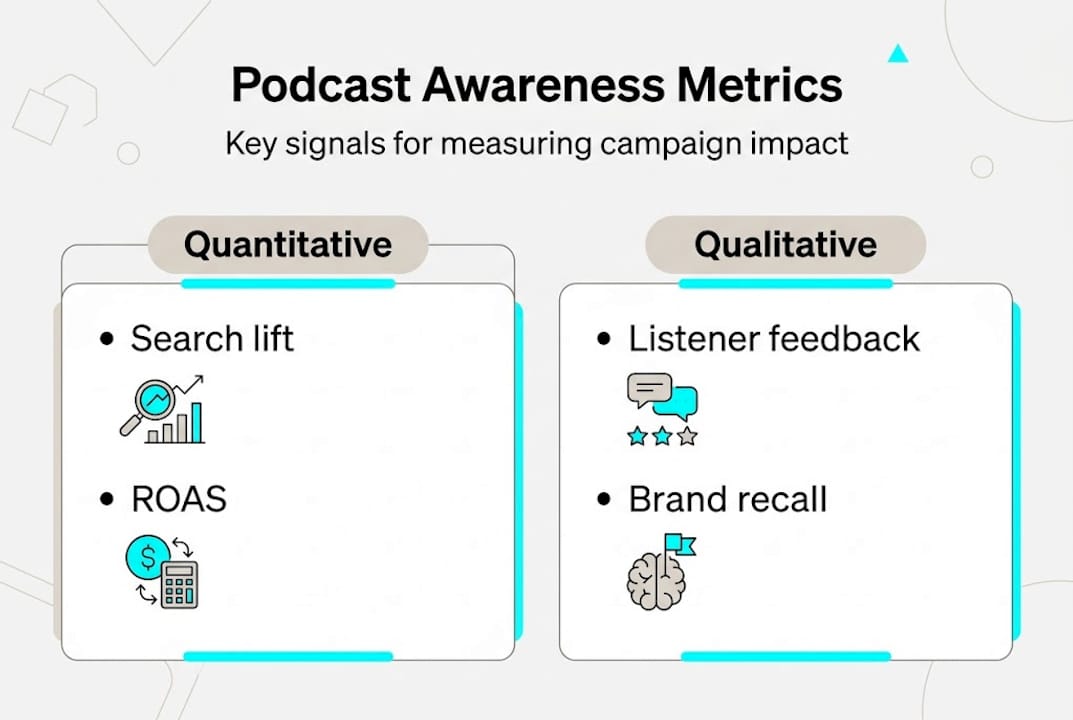
The smartest measurement setup combines both quantitative signals (search lift, UTMs, ROAS) and qualitative validation (brand recall studies, listener surveys). Together they give you a defensible case that podcast investment is driving real business outcomes, not just vanity metrics.
The data-driven reality: What most marketers miss about podcast awareness
Here’s something I want to be direct about. Podcast marketing is not a set-and-forget channel. I see brands launch one eight-week campaign, see decent numbers, and then pull back before the compounding effects kick in. That’s leaving real money on the table.
The brands winning at podcast awareness right now are doing something different. They’re treating organic mention moments with the same seriousness as paid placements. They’re monitoring what hosts are saying about their category, not just their brand. And they’re using those insights to drive storytelling across every channel, not just the podcast buy.
There’s also a dangerous habit of evaluating podcast performance purely through CPM or CPC lenses. Those metrics don’t capture the trust transfer, the sustained recall, or the behavioral lift that makes podcast advertising uniquely powerful. When you force podcast ROI into a display advertising framework, you’ll always undervalue it.
The brands that get this right use programmatic strategies as a testing ground, then move quickly to host-read partnerships once they’ve identified shows where their audience is genuinely engaged. They’re iterating constantly, repurposing the good stuff, and letting data tell them where to go deeper.
Podcast awareness is an ongoing conversation with your audience, not a campaign you run once and move on from.
Leverage podcast moments for your brand with Prodcast
Tracking podcast mentions manually is a grind. You’d need to listen to thousands of hours of audio to catch every moment your brand, product, or category gets discussed. That’s exactly the problem Prodcast solves.

Prodcast is an AI-powered platform that analyzes podcast transcripts at scale, identifying brand mentions, trending products, and key discussion moments across thousands of shows in real time. You get structured, searchable data that shows exactly what audiences are hearing and caring about right now. No more scrubbing audio files or guessing where your brand landed.
Discover podcast moments as they happen, amplify them into campaigns, and attribute awareness lift directly to specific podcast content. Whether you want to catch organic mentions before they fade or build a highlight reel of your best host endorsements, the Prodcast platform has the tools to turn those conversations into measurable brand growth.
Frequently asked questions
How do podcast ads compare to social media for brand awareness?
Podcast ads consistently drive higher lifts in unaided brand awareness, with up to 85% lift recorded in benchmark reports, outperforming typical social media campaign results by a wide margin.
What is a host-read ad, and why is it effective?
A host-read ad is delivered in the podcast host’s own voice, creating authentic trust transfer with their audience, and yields conversion rates 3x higher than programmatic alternatives.
How long should a podcast campaign run to maximize awareness?
Sustained campaigns of eight weeks or longer consistently show the greatest brand lift and the most durable awareness gains compared to short-burst placements.
What key metrics should I track for podcast awareness?
Track unaided and aided brand recall through pre and post-campaign studies, alongside branded search lift and podcast-attributed web actions, since 45–85% unaided and 40–70% aided awareness lifts are the benchmarks to beat.