CATEGORIES
TAGS
How speech to text unlocks podcast insights and trends
TL;DR:
- Speech to text transforms podcast audio into searchable, shareable content, unlocking trends and expert insights.
- While current ASR models achieve low error rates on studio recordings, noisy, multi-speaker podcasts still challenge accuracy, requiring human proofreading.
You’ve probably been there. A friend mentions some product or tool they heard about on a podcast, and you know it was from that one episode you half-listened to on your commute last Tuesday. You scrub back, fast forward, and still can’t find it. That’s the core frustration with podcasts. All that expert knowledge, locked inside an audio file with no easy way to search it, skim it, or pull the good stuff out. Speech to text is changing that in a big way, and if you’re someone who listens to podcasts to spot trends, find products, or learn from industry experts, this is the guide you’ve been waiting for.
Table of Contents
- Why speech to text matters in podcasts
- How accurate is podcast speech to text in 2026?
- Common challenges and how to improve accuracy
- From transcript to actionable insights: What listeners can do
- What most people miss about speech to text in podcasts
- Discover moments and trends from top podcasts
- Frequently asked questions
Key Takeaways
| Point | Details |
|---|---|
| Transcripts unlock discovery | Speech to text lets you search, share, and analyze podcast insights quickly. |
| Accuracy varies by context | Studio audio has low error rates, but noisy, real-world podcasts are more challenging. |
| Optimize for best results | Recording cleanly and proofreading transcripts is essential for practical use. |
| AI needs human wisdom | Even the best models require human review to catch all details and meaning. |
Why speech to text matters in podcasts
Having introduced the need for making podcasts searchable, let’s unpack the true value that speech to text brings starting from the listener’s perspective.
Podcasts have always had a discovery problem. Unlike a blog post or a YouTube video with captions, audio content is essentially invisible to search engines and to your own memory. If a host mentions an amazing supplement, a must-read book, or an emerging AI tool, that mention disappears into the audio stream unless you were paying close attention at exactly the right moment. This is a real problem because, as vocova.app confirms, podcasts contain actionable trends and expert knowledge but lack visibility without transcripts.
Speech to text technology, also known as automatic speech recognition or ASR, converts spoken audio into readable text. Once you have that text, everything changes. Here’s what becomes possible:
- Search by keyword to find exactly when a host or guest mentions a brand, product, or topic
- Extract quotes from expert interviews without replaying entire episodes
- Generate summaries that give you the highlights in two minutes instead of two hours
- Improve SEO for podcasters, since search engines can now index spoken content
- Boost accessibility for deaf or hard-of-hearing listeners
Listeners benefit because they can scan instead of scrub. Researchers benefit because they can analyze patterns across hundreds of episodes. Content creators benefit because transcripts turn one episode into blog posts, social media clips, newsletters, and more. Even AI-powered podcast engagement tools depend heavily on accurate transcripts to surface the moments that matter.
“Transcripts are the bridge between spoken expertise and searchable, shareable knowledge. Without them, most podcast value simply walks out the door.” This is the mindset driving every serious podcaster and listener tool in 2026.
The AI trends in audio content space are evolving fast, and smart listeners are already using transcripts to get ahead. Knowing what’s being discussed across hundreds of shows, before a trend goes mainstream, is a genuine competitive advantage. And it all starts with turning speech into text.
For anyone who cares about podcast SEO best practices, transcripts are no longer optional. They’re the backbone of a discoverable, searchable audio strategy.
How accurate is podcast speech to text in 2026?
Now that we know why speech to text matters, let’s examine just how trustworthy these tools are in today’s podcast landscape.
Here’s the honest truth. Not all transcripts are created equal, and the accuracy gap between a studio recording and a chaotic three-person panel show is enormous. The metric used to measure accuracy is called Word Error Rate, or WER. Lower WER means fewer mistakes. Higher WER means you’ll be doing a lot of cleanup.
According to real-world benchmarking data, WhisperX achieved a WER of 12.81% on actual podcast audio, the lowest of any model tested. That’s impressive, but it also means roughly one word in eight is wrong. For a casual listener summary, that might be fine. For a legal transcript or product research, that’s a problem.
Here’s how top models compare in real podcast conditions:
| Model | WER on studio audio | WER on noisy/multi-speaker podcasts |
|---|---|---|
| WhisperX | ~3% | ~12.81% |
| Deepgram | ~4% | ~14% |
| Rev.ai | ~4% | ~15% |
| AssemblyAI | ~5% | ~16% |
| Google STT | ~5% | ~18% |
| AWS Transcribe | ~6% | ~20% |
| Azure Speech | ~6% | ~21% |
| IBM Watson | ~8% | ~24% |
Modern ASR models like Deepgram and Whisper reach 3 to 5% WER on clean studio audio, but jump to 10 to 25% when the recording involves background noise, overlapping speakers, or unusual accents. Rev.ai’s own testing found that lab benchmarks of 2 to 5% WER are achievable in clean audio conditions, but real podcast conversations push those numbers much higher.
What drives errors up? A few big culprits:
- Two people talking at the same time
- Remote recordings where connection quality varies
- Guests with strong accents or unusual speech patterns
- Technical jargon, brand names, or product names the model hasn’t seen before
- Fast talkers and hosts who love to interrupt
Pro Tip: Always proofread AI transcripts before using them for research, product discovery, or sharing publicly. Numbers, email addresses, brand names, and niche technical terms are where most tools stumble. A quick five-minute read-through can save you from some embarrassing errors.
Understanding these limitations helps you use transcripts more smartly. A good approach to production for powerful product discovery involves pairing high-quality audio with a reliable ASR model. That combination keeps error rates low and makes the final transcript genuinely useful.
The synthetic voices in transcription space is also worth watching. As voice quality improves and AI-generated audio becomes more common, transcription models are being trained on new types of input, which is steadily pushing accuracy higher across the board.
Common challenges and how to improve accuracy
Understanding what’s possible, let’s look at real-world hurdles and how both podcasters and listeners can optimize for accuracy.
If you’ve ever tried to transcribe a podcast and ended up with something that looked like autocorrect gone wild, you’re not alone. Several factors consistently tank accuracy, and knowing them helps you either avoid them or work around them.

The biggest issue is background noise. Fans, street sounds, keyboard clicks, and even room echo can significantly disrupt transcription. Background noise can increase error rates by 15 to 20%, which is why separate audio tracks and clean recording environments are so important for anyone serious about accuracy.
Other common challenges include:
- Crosstalk and overlapping speech: When two people speak simultaneously, most ASR models struggle to attribute words correctly and often drop phrases entirely
- Multiple speakers without labels: The model can’t tell who said what without speaker diarization (the technical term for splitting a transcript by individual speaker)
- Domain-specific vocabulary: Podcast niches like biotech, crypto, or niche fitness communities use terms that general ASR models have never been trained on
- Fast speech and filler words: “Um,” “uh,” and rapid delivery patterns create noise that the model has to decide whether to include or skip
- Thick regional or international accents: Models trained predominantly on North American English struggle more with accents from other English-speaking regions
The good news is that standard methods like clean and separate tracks, diarization, custom vocabulary, and timestamps dramatically reduce these issues. Here’s what creators and listeners can do in practice:
For podcast creators, the biggest wins come from recording each speaker on a separate microphone track, using noise-canceling software in post-production, and submitting a custom vocabulary list (brand names, product names, industry terms) to your ASR tool before processing.
For listeners using third-party transcription tools or platforms, look for tools that offer speaker labels and timestamps. These make it much easier to locate specific moments and understand who said what.
Pro Tip: If you’re working with a long interview episode (anything over 45 minutes), split the audio file into smaller chunks before transcribing. Many ASR tools perform better on shorter segments, and errors tend to compound over long files.
Audio preprocessing for accuracy is also a simple step that makes a big difference. Removing dead air, normalizing volume levels, and cutting heavy reverb before running transcription can meaningfully reduce your final WER.
Combining these approaches with smart best podcast workflow tips gives you a much cleaner transcript to work with, which means the insights you pull from it are far more reliable.
From transcript to actionable insights: What listeners can do
With accuracy maximized, here’s how transcripts translate into real-world value for podcast listeners.
Getting a transcript is step one. Actually using it to find trends, spot product recommendations, and extract expert opinions is where the real magic happens. And this is where listeners who are tuned into transcript-powered tools have a massive edge over those still scrubbing audio manually.
Here’s a practical comparison of how manual note-taking stacks up against AI-powered transcripts:
| Method | Time to find a product mention | Searchable? | Shareable quote? | Trend analysis? |
|---|---|---|---|---|
| Manual note-taking | 15 to 45 minutes per episode | No | Paraphrased only | Very difficult |
| AI-powered transcript | Under 30 seconds | Yes | Word-for-word | Easy with batch tools |
| Curated platform (Prodcast) | Instant | Yes | Highlighted clips | Real-time across shows |
The efficiency gain is obvious. With AI transcripts, podcasts become 95 to 99% accessible and SEO-ready with just light editing, turning hours of content into a searchable knowledge base almost instantly.
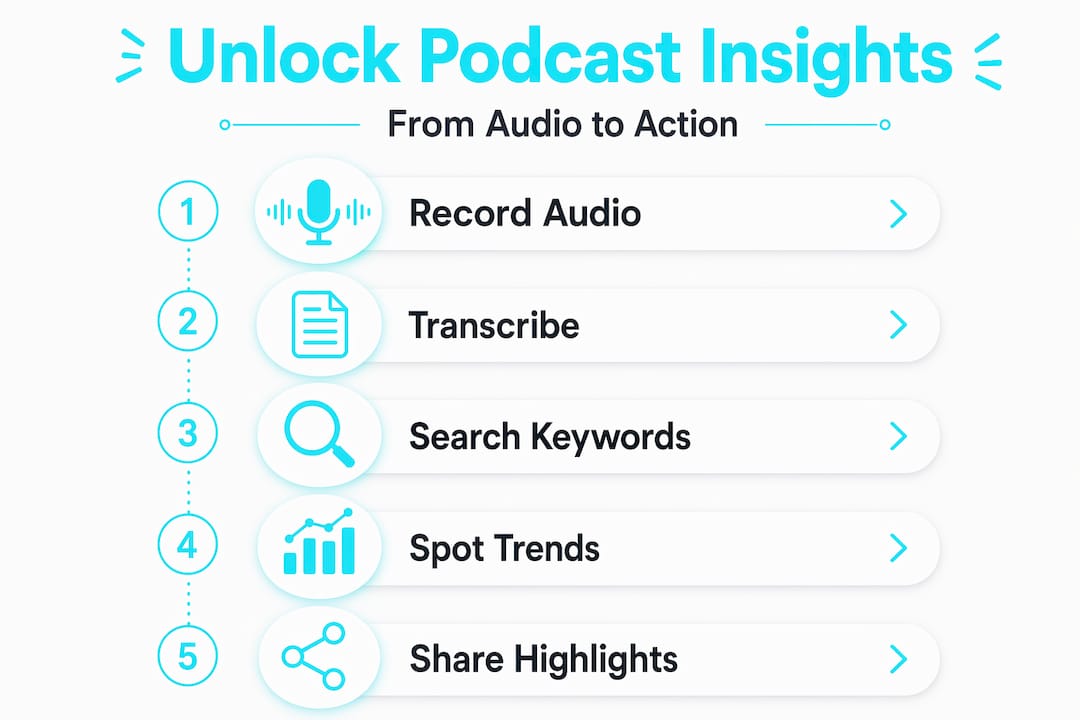
Here’s a step-by-step approach to turning a transcript into an actual action plan:
- Search for product or brand keywords first. Look for terms relevant to your interests, whether that’s supplements, SaaS tools, investment strategies, or skincare brands.
- Identify the surrounding context. A single mention doesn’t tell you much. Is the host enthusiastic? Did the guest use it personally? Is this a sponsored mention or organic?
- Tag the expert who made the recommendation. An endorsement from a well-known industry voice carries more weight than a passing mention.
- Group mentions by episode and date to see if a product is gaining momentum across multiple shows or just appearing in one-off episodes.
- Create a shortlist of the products or tools that appear repeatedly, with strong endorsements, across your niche podcast categories.
Experts also emphasize that batch transcripts outperform streaming for podcasts, and that adding context tags (like topic, guest name, or product category) makes deep analysis far more powerful. This is especially true when you’re trying to track trends across dozens of shows simultaneously.
Staying on top of podcast content trends becomes much more manageable when you’re working from structured transcript data rather than relying on memory or manual notes.
The AI for discoverability space is applying similar principles to other forms of content, and podcasting is catching up fast. The listeners who learn to work with transcripts now will have a significant head start.
What most people miss about speech to text in podcasts
Here’s the perspective that often gets left out of these conversations. Everyone talks about accuracy benchmarks and model comparisons, but very few people address the gap between what AI transcription promises and what it actually delivers when you’re in the middle of real podcast research.
Lab benchmarks sound impressive. A 3% WER on clean audio makes it seem like these tools are basically perfect. But real conversations challenge every model, and the podcast format is basically a stress test for ASR. Interruptions, inside jokes, cultural references, brand names spelled unusually, numbers rattled off quickly, guests switching between technical and casual language. All of that adds up.
The conventional wisdom assumes AI will eventually solve this perfectly, and all you need to do is wait for the next model release. That’s too optimistic. Even the best tools today miss numbers, emails, nuance, and context. Proofreading and human review aren’t optional extras. They’re part of the workflow.
What that means practically is this: transcripts are an incredibly powerful tool, but they’re a first draft. They surface the signal, but a human still needs to confirm what that signal means. The nuance of a host’s tone, the way sarcasm or skepticism changes the meaning of a product recommendation, the difference between “I tried this once” and “I use this every single day,” those things live in the audio. Text alone doesn’t always capture them.
This is why podcasts are popular in the first place. The medium creates authentic, unscripted conversation that text can approximate but not fully replicate. The smartest way to use speech to text is as a discovery layer, not a replacement for actually listening to the moments that matter most to you.
Use transcripts to find the needle in the haystack. Then listen to the needle.
Discover moments and trends from top podcasts
If you want to experience speech to text powered podcast insights firsthand, here’s how to get started.
Prodcast does the heavy lifting so you don’t have to. The platform uses state-of-the-art ASR models to analyze podcast transcripts at scale, then surfaces the product mentions, expert recommendations, and trending topics that matter most to listeners like you.

Instead of scrubbing through hours of audio or building your own transcription workflow, you can jump straight to the insights. Search for a product, browse clips by topic or creator, and see what’s trending across entire podcast categories in real time. The discover podcast moments library is where expert highlights live, organized and searchable, so you never miss the good stuff again. Transcripts are the engine. Prodcast is what makes them actually useful.
Frequently asked questions
What is the Word Error Rate (WER) for podcast speech to text in 2026?
WER in real podcasts typically ranges from 10 to 25%, while studio-quality audio can achieve 3 to 5% under ideal conditions. The gap between lab claims and real-world podcast performance is significant.
Which tools offer the best podcast transcription accuracy?
WhisperX, Deepgram, Rev.ai, and AssemblyAI lead the field, with WhisperX scoring the lowest WER of 12.81% on actual podcast audio in independent testing.
How can I improve the accuracy of my podcast transcript?
Recording each speaker on a separate audio track and reviewing the final transcript manually are the two most effective steps, since background noise alone can raise error rates by 15 to 20% under typical conditions.
Are AI transcripts good enough for accessibility and SEO in podcasts?
With light editing, AI transcripts deliver 95 to 99% accessibility and strong SEO value for podcasters, though full accuracy for research or legal purposes still requires a human review pass.