CATEGORIES
TAGS
How to boost podcast listener engagement that counts

TL;DR:
- Measuring true podcast engagement requires analyzing behavioral and emotional signals beyond simple downloads. Combining quantitative platform data with qualitative feedback from reviews, emails, and social mentions provides a fuller picture. Focusing on persistent listening and actionable interactions drives meaningful audience loyalty and product discovery.
Downloads are going up. Subscriber numbers look great. But here’s the uncomfortable truth: those numbers don’t tell you whether anyone is actually listening, caring, or acting on what they hear. Podcast engagement is multi-dimensional, and downloads alone can paint a wildly misleading picture. In this guide, you’ll learn exactly how to measure real listener engagement, what tools actually capture the good stuff, and how to systematically increase the moments that matter — including the ones where listeners reach for their wallets.
Table of Contents
- Understanding podcast listener engagement beyond downloads
- Tools and data sources you need to measure engagement
- Step-by-step: How to boost podcast listener engagement
- How to verify your engagement efforts: Tracking and troubleshooting
- Why real podcast engagement is more than just numbers
- Unlock deeper engagement and product discovery
- Frequently asked questions
Key Takeaways
| Point | Details |
|---|---|
| Engagement is multidimensional | True listener engagement blends analytics with qualitative and behavioral signals for insight. |
| Downloads can mislead | High download numbers don’t mean high engagement or audience interest. |
| Silent audiences matter | Some of the most committed listeners rarely interact but still drive show impact. |
| Tools and data work together | Combining platform analytics with reviews, emails, and social feedback provides a complete view. |
| Actionable steps boost results | Strategic episode structure and easy product discovery encourage audience participation and brand interest. |
Understanding podcast listener engagement beyond downloads
To address this mismatch, let’s establish how real engagement differs from shallow metrics and what signals actually matter.
A download tells you someone’s device requested a file. It doesn’t tell you whether they hit play, listened past the first two minutes, or paused the episode to Google a product recommendation. That gap is where most creators and marketers get lost.
Real engagement is behavioral and emotional. Think about what actually happens when a podcast lands with someone. They re-listen to a segment. They leave a review. They DM the host. They buy the book mentioned at the 22-minute mark. Those are engagement signals, and most of them never show up in a standard analytics dashboard.
Here’s a quick breakdown of how different metrics stack up:
| Metric type | What it measures | Reliability as engagement signal |
|---|---|---|
| Downloads | File requests | Low (device, not human) |
| Completion rate | How far listeners get | Medium-High |
| Re-listens | Return to specific segments | High |
| Reviews and ratings | Overt audience sentiment | High |
| Social mentions | Public sharing behavior | Medium |
| Email replies | Direct listener response | Very High |
| Product click-throughs | Action taken on content | Very High |
The engagement metrics breakdown picture gets more interesting when you look at behavioral signals like skips and chapter jumps. A listener skipping your sponsor segment repeatedly? That’s data. A listener rewinding a product recommendation three times? That’s gold.
What makes this tricky is that different data channels capture completely different sides of the story. Platform analytics give you numbers. Emails give you emotion. Reviews give you language your audience actually uses. You need all of them working together, and triangulating platform analytics with qualitative signals is the only way to get a full picture.
Here are the key engagement signals you should be tracking across channels:
- Completion rate per episode (especially compared to your average)
- Re-listen rate on specific segments or chapters
- Review volume and sentiment on Apple and Spotify
- Direct messages and email replies referencing episode content
- Social shares and tags tied to specific episodes or moments
- Click-through rates on product or show note links
- Community participation in Discord, Facebook groups, or Reddit threads
One more thing worth flagging: loyal audiences may be completely silent in public forums. Just because no one is posting in your community doesn’t mean no one cares. Some of your most dedicated listeners never comment anywhere. They just keep showing up every week, finishing every episode, and buying what you recommend.
Pro Tip: Don’t let one channel dominate your thinking. If Spotify analytics look flat but your email replies are rich and personal, that’s a signal your audience is engaged but private. Weight your channels by depth of signal, not volume of data. The unlocking podcast metrics approach means pulling insights from every layer, not just the dashboard front page.
Tools and data sources you need to measure engagement
Once engagement is clearly defined, you need the right tools and sources to capture it. Here’s what’s essential.
No single tool gives you everything. That’s just the reality. But together, the right stack gives you a genuinely detailed picture of what your listeners are doing, feeling, and buying.
Start with your platform analytics. Apple Podcasts Connect and Spotify for Podcasters both offer listener data, including plays, listeners, and in some cases, completion rates. It’s worth noting that completion rate availability depends on player instrumentation, meaning not every player reports this data equally. Spotify tends to be more granular here.
Beyond the big two, tools like Chartable (for attribution tracking), Buzzsprout, and Podtrac offer aggregate listener data across distribution platforms. Each has a different strength.
| Tool / channel | Best for | Engagement signal captured |
|---|---|---|
| Apple Podcasts Connect | iOS listener behavior | Plays, completion, follows |
| Spotify for Podcasters | Streaming behavior | Starts, streams, episode performance |
| Chartable | Attribution and growth tracking | Source of new listeners, ad performance |
| Listener surveys (Typeform, etc.) | Qualitative depth | Preferences, product interest, satisfaction |
| Email list | Direct dialogue | Replies, open rates, product interest |
| Social media monitoring | Public sentiment | Shares, tags, organic conversation |
| Community platforms (Discord) | Group behavior | Discussion depth, repeat participation |
Check out data-driven engagement insights to see how layering these sources creates a much richer signal than any single dashboard.
Listener surveys are criminally underused. A short three-question survey dropped in your show notes and emailed to your list can surface more useful information than months of platform analytics. Ask: what part of this episode stuck with you? Did you look anything up after listening? What would make the show more useful?
Reviews on Apple Podcasts are another often-ignored goldmine. People don’t leave reviews casually. When they do, they’re telling you exactly what resonated and why. Read every one. Tag the themes. Over time, you’ll start seeing patterns that tell you which episodes drove real impact.
For key metrics for engagement, the goal is to build a simple tracker that pulls from at least three of these sources weekly. Don’t try to monitor everything at once. Pick your highest-signal channels and stay consistent.
Step-by-step: How to boost podcast listener engagement
Now that you have the right tools in place, here’s how to strategically boost actual listener participation and interest.
Engagement doesn’t just happen. It’s designed into the episode before you hit record, and it’s nurtured between releases. Here’s a practical framework that works.
1. Hook listeners in the first 90 seconds. Don’t waste the cold open on pleasantries or a lengthy intro. Tell listeners exactly what they’ll get and why it matters to them right now. A specific tease (“At minute 34 we talk about the supplement this guest swears by”) works better than a generic welcome.
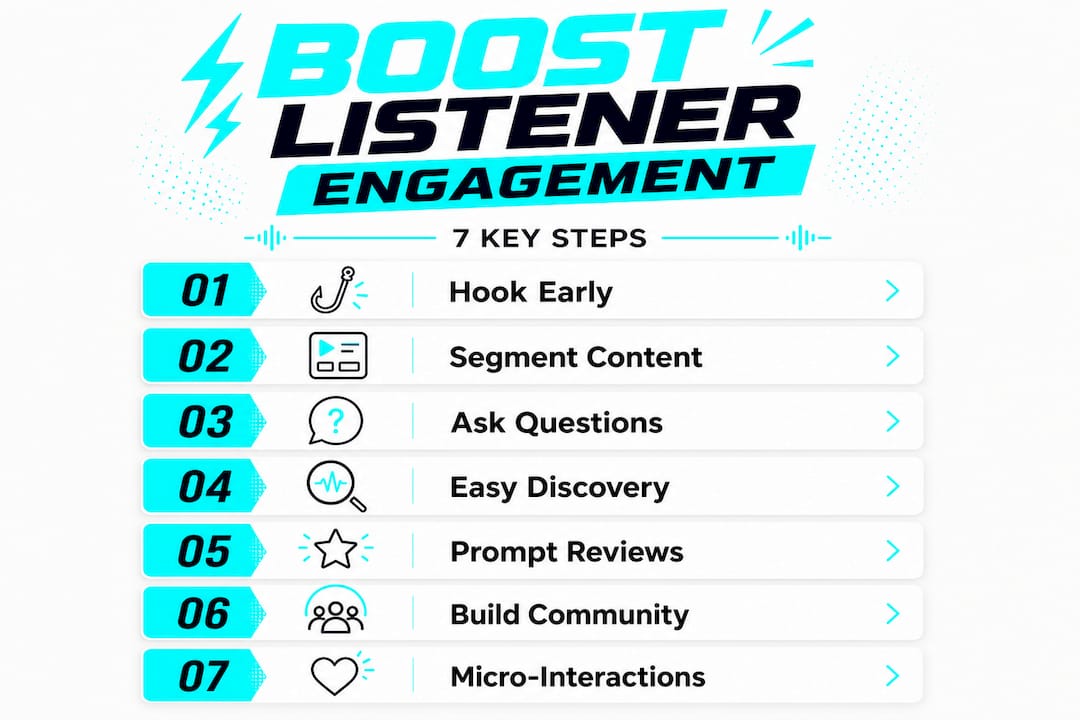
2. Build chapter markers and named segments. Listeners re-engage when they know where to find the good stuff. Named chapters on Spotify let people jump back to the product mention or key insight they want to hear again. That re-listen is an engagement event. Make it easy.
3. Ask one specific question per episode. Not “let us know your thoughts” but something like “Reply to this email and tell me: have you tried this approach? What happened?” Specificity drives response. Vague calls to action disappear into the noise.
4. Make product discovery frictionless. If a guest mentions a book, a supplement, or a software tool, that product should appear in your show notes with a direct link within the hour. Listeners who are curious won’t search for long. If the link isn’t there, the moment is gone. Combining quantitative analytics with qualitative feedback like click-through tracking on those show note links tells you exactly which product mentions sparked action.
5. Prompt reviews at the right moment. The best time to ask for a review is right after delivering a genuinely valuable insight, not at the beginning or end of every episode by habit. Say something like “If this conversation shifted how you think about X, an honest review means everything to us.” Specificity and timing matter.
6. Create a lightweight community touchpoint. A monthly listener Q&A, a simple Discord server, or even a curated newsletter thread gives listeners a place to engage beyond the audio file. You don’t need a massive community. A small, active one tells you far more than a large, silent one.
7. Use short polls and interactive content. Instagram stories, Spotify polls, and email polls take seconds for listeners to complete. The data is shallow but fast, and even a quick directional signal (“Did you prefer the interview or solo format this month?”) can inform your next few episodes.
Pro Tip: Short micro-engagements like a one-question poll or a clickable product link are easy wins that build the habit of interaction. Check out these audience engagement strategies to see how small nudges can create compounding engagement over time.
How to verify your engagement efforts: Tracking and troubleshooting
After implementing engagement strategies, verification is key to ensuring your efforts translate to genuine audience impact.

Running engagement tactics without measuring their effect is like cooking without tasting. Here’s how to close that loop and troubleshoot when things don’t go as expected.
First, separate your metrics by time horizon. Short-term signals like poll responses, email replies, and review spikes give you fast feedback on individual episodes. Long-term signals like completion rate trends, subscriber retention, and community size growth tell you whether your engagement strategy is actually building something durable.
| Timeframe | Metrics to watch | What they reveal |
|---|---|---|
| Per episode (0-7 days) | Reviews, replies, click-throughs, poll responses | Immediate resonance and action |
| Monthly | Completion rate average, email open/reply rate | Content quality and habit formation |
| Quarterly | Subscriber growth, retention, community growth | Strategy effectiveness over time |
The most common mistake? Fixating on one data point. A single episode getting unusually high downloads might just be an algorithm boost, not a genuine shift in engagement. Always look for corroborating signals before drawing conclusions.
Real engagement isn’t always loud. A listener who finishes every episode, never posts online, and quietly buys every recommended product is more engaged than someone who comments on every social post but skips half the audio. Measure the full picture, always.
Here are common engagement measurement pitfalls and how to fix them:
- Problem: Completion rate looks high but reviews are thin. Fix: Your content is landing but you’re not asking for feedback at the right moment.
- Problem: Social mentions are high but email replies are zero. Fix: Your audience is public-facing. Move calls to action to where they already are.
- Problem: Downloads are climbing but survey responses are flat. Fix: Your audience may be growing in size but not deepening in connection. Try a more specific prompt.
- Problem: Community engagement is low. Fix: Check whether low discussion actually means low engagement. Silent listeners are real. Track listening behavior instead.
- Problem: Product link clicks are low despite mention in the episode. Fix: Make sure the link is in the show notes, sent via email, and visible on social within 24 hours of release.
Always triangulate your analytics and feedback rather than acting on any one signal in isolation. The truth usually lives in the overlap. For tracking advertising effectiveness metrics, the same principle applies: one metric never tells the whole story.
Why real podcast engagement is more than just numbers
Here’s the thing that most engagement guides won’t say out loud: optimizing for visible engagement can actually make your podcast worse.
When creators chase comments, shares, and review counts, they start making content designed to prompt reaction rather than deliver value. That’s a subtle trap. The episodes that go viral on social are not always the episodes that change someone’s life or send them to buy something their host recommended.
Some of the most commercially powerful podcast audiences are almost completely silent online. They don’t tweet. They don’t post in Discord. They finish every episode on a Monday morning commute and then quietly act on what they heard. Loyal but silent audiences prove that engagement can be invisible to metrics entirely, and yet these listeners drive real purchase behavior and long-term show loyalty.
The contrarian advice here is this: instead of chasing more interaction, focus on persistent listening. If your completion rates are high and your subscriber retention is solid, you are doing something right, even if your comments section is quiet. Protect that first.
The most underrated engagement signal in podcasting is the listener who keeps showing up. Every episode. Every week. No fanfare, no public comment. Just presence. That’s the audience worth building for.
Marketers who understand this shift their focus from “how many people reacted?” to “how many people kept listening and then took action?” That’s where podcast metrics for brands get genuinely interesting, and that’s the level of analysis that actually connects audio content to business outcomes.
The bottom line is that real engagement is a combination of persistent behavior, occasional overt interaction, and action outside the episode. Build for all three. Measure all three. And resist the urge to optimize only for what’s easy to count.
Unlock deeper engagement and product discovery
You’ve got the framework. You understand what real engagement looks like and how to measure it accurately. Now here’s how to go even further.

Prodcast is built for exactly this kind of deeper intelligence. Our AI-powered platform scans podcast transcripts across thousands of shows to surface which products, brands, and tools are actually being mentioned and how audiences are responding. Whether you’re a listener who wants to track down the supplement a host mentioned, or a marketer trying to understand what your target audience is genuinely hearing and caring about, Prodcast turns audio conversations into structured, actionable data. You can explore specific episode products like those featured in the Mass Persuasion episode or track trending consumer goods like Monster Energy product mentions across shows. Discover more with Prodcast and turn podcast conversations into real insight.
Frequently asked questions
How do I know if my podcast actually engages listeners?
Track both quantitative data like completion rates and qualitative signals like reviews and direct listener replies. Combining analytics and feedback gives you a far more reliable picture than any single metric.
What is a “silent” podcast audience?
A silent audience listens regularly and may even act on what they hear, but rarely interacts publicly on social media or in community spaces. Silent but loyal audiences often look like low engagement in community dashboards but are actually your most committed listeners.
Which tools give the most complete engagement data?
No single tool covers everything, so the best approach is combining platform analytics like Apple Podcasts and Spotify with email feedback, listener surveys, and social monitoring. No single channel provides a full engagement picture, which is why layering sources matters.
How do I help listeners discover episode products easily?
Include direct product links in your show notes immediately after publishing, mention them in your email newsletter, and repeat the recommendation on social media. Platforms like Prodcast can also surface these product mentions automatically, making discovery effortless for listeners who want to act quickly.