CATEGORIES
TAGS
Podcast engagement strategies: 58% of Americans are listening

TL;DR:
- Engagement metrics like completion rates and listen duration are crucial for measuring podcast success.
- Consistent format, strong hooks, and guest collaboration boost audience retention and participation.
- Multi-platform distribution and niche focus significantly increase discoverability and meaningful listener engagement.
Podcast listenership is at an all-time high, with 58% of Americans tuning in monthly. Yet most marketers are still measuring success by downloads alone. That’s like judging a concert by how many people bought tickets but never checking if anyone stayed for the show. The real opportunity is in engagement: who’s listening, how long, and what they do next. If you’re a marketer or advertiser trying to connect with niche audiences through audio, this guide is for you. We’re going to walk through data-backed strategies that move the needle from passive listeners to active, action-taking fans.
Table of Contents
- Understand podcast audience behavior: Data is your foundation
- Optimize content for engagement: Formats, pacing, and guest strategies
- Multi-platform distribution and discoverability: Grow your reach
- Activate true engagement: Ads, calls to action, and repurposed content
- Why niche engagement matters more than chasing pure size
- Take your podcast engagement to the next level with Prodcast
- Frequently asked questions
Key Takeaways
| Point | Details |
|---|---|
| Data-driven insights | Analyzing listener behavior and completion rates is critical for real engagement. |
| Format and frequency matter | Consistent, niche-focused content outperforms general, infrequent shows. |
| Leverage cross-platform | Publishing on multiple platforms can double your discoverability. |
| Host-read ads drive actions | Personalized, authentic ads prompt higher listener response and trust. |
| Repurposing content extends reach | Spinning episodes into clips, blogs, and social posts finds new audiences and keeps engagement high. |
Understand podcast audience behavior: Data is your foundation
Before you can improve engagement, you need to understand what you’re actually measuring. There’s a big difference between consumption, engagement, and conversion, and confusing them leads to wasted budget.
Consumption is the raw stuff: downloads, streams, unique listeners. Engagement goes deeper: completion rates, average listen duration, and return visits. Conversion is the payoff: clicks, sign-ups, purchases, and promo code redemptions. Most dashboards hand you consumption data by default. You have to dig for the rest.
Here’s a quick snapshot of where the U.S. audience stands right now:
| Metric | Stat |
|---|---|
| Ever listened to a podcast | 80% of Americans |
| Monthly listeners | 58% |
| Weekly listeners | 45% |
| Avg. hours per week (weekly listeners) | 6.3 hours |
Those numbers are significant. Weekly listeners are practically binging audio content. That’s your sweet spot.
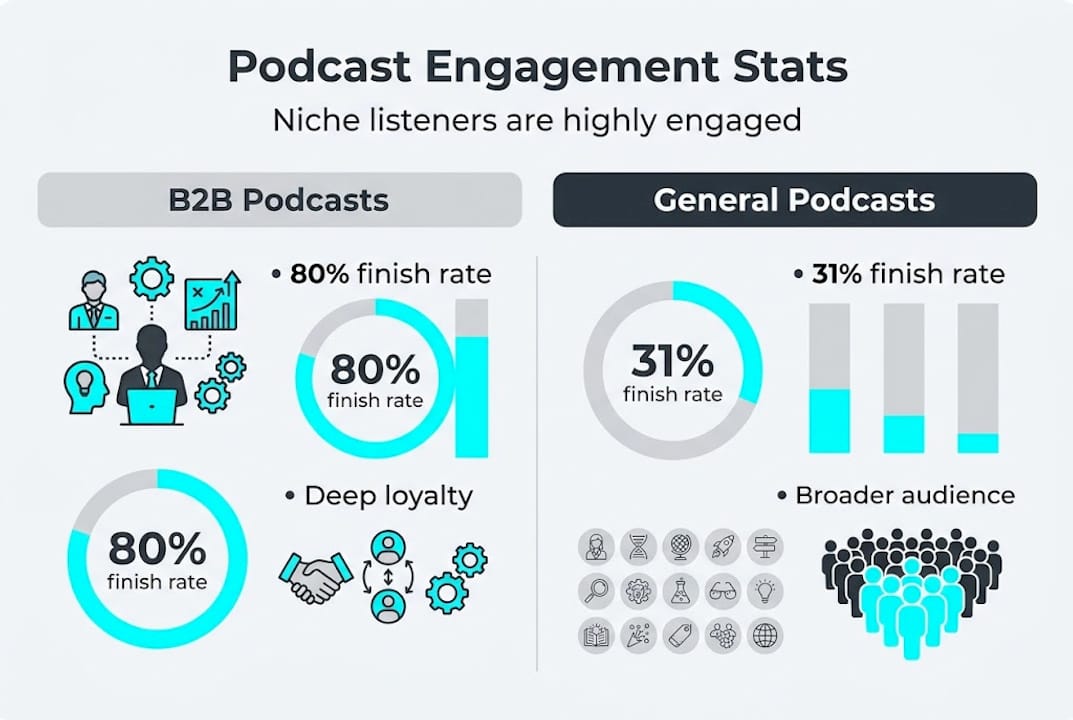
Niche audiences, especially in B2B, go even deeper. Completion rates for business and professional podcasts regularly exceed 80%, which dwarfs what most video content achieves. When someone finds a show that speaks directly to their work or passion, they don’t just hit play. They finish the episode, subscribe, and come back next week.
So where do you find this data? Platforms like Spotify for Podcasters, Apple Podcasts Connect, and YouTube Studio all give you listener analytics. Your hosting dashboard (think Buzzsprout, Transistor, or Podbean) layers in download geography and device data. Cross-referencing these sources gives you a fuller picture of your podcast audience data.
The key metrics worth tracking:
- Completion rate per episode (aim for 70%+)
- Average listen duration vs. episode length
- Subscriber growth rate week over week
- Drop-off points within episodes
- Click-through rate on links in show notes
Understanding podcast engagement metrics isn’t just a nice-to-have. It’s the foundation everything else is built on. Once you know where listeners are tuning out, you can fix it. Once you know which episodes drive the most return visits, you can replicate that format. That’s the power of data-driven insights in practice.
Pro Tip: Set a monthly data review ritual. Pull completion rates and listen duration for every episode, then compare them against your content format and topic. Patterns will emerge fast.
Optimize content for engagement: Formats, pacing, and guest strategies
Once your data is in hand, use it to refine the show itself. This is where a lot of podcasters leave engagement on the table. They focus on recording and publishing but not on the structure that keeps people hooked.
Consistent weekly releases and a tight niche focus are two of the biggest drivers of completion rates and algorithmic reward. Irregular publishing schedules confuse listeners and kill momentum. If you can only manage bi-weekly, commit to it. Predictability builds habit.
Format matters too. Here’s how the main episode types stack up:
| Format | Avg. completion rate | Best for |
|---|---|---|
| Full-length solo (45-60 min) | 65-70% | Deep-dive authority building |
| Micro-episodes (10-15 min) | 75-80% | Busy professionals, commuters |
| Guest interview episodes | 60-68% | Audience growth, cross-promotion |
| Panel/roundtable | 55-62% | Variety, broad topic coverage |
Micro-episodes punch above their weight for completion. But guest episodes are your growth engine. When a respected guest brings their audience to your show, you get a warm introduction to a community that already trusts that person.

Guest swaps take this further. You appear on their show, they appear on yours. Both audiences win. It’s one of the most underrated audience engagement insights strategies out there, and it costs nothing but coordination.
A few things that consistently lift engagement regardless of format:
- Strong cold opens: Hook the listener in the first 90 seconds or lose them
- Clear episode structure: Tell people what they’ll learn before you teach it
- Pacing variation: Mix fast-paced exchanges with slower, reflective moments
- Episode chapters: Platforms like Spotify support chapter markers, which help listeners navigate and return
For growing podcast audience numbers, check out podcast marketing tips that go beyond the basics.
Pro Tip: Use guest cross-promotion intentionally. Before the episode drops, coordinate with your guest to share a specific clip or quote on social. Give them the asset. Make it easy for them to promote it. A 30-second audiogram can drive hundreds of new listeners from a single guest’s audience.
Multi-platform distribution and discoverability: Grow your reach
Even the best content falls flat without discoverability. You can record a brilliant episode and still get zero traction if it only lives in one place.
Multi-platform distribution boosts discoverability by 200%. That’s not a rounding error. It’s the difference between a show that grows and one that stalls.
Here’s why each platform matters:
| Platform | Key advantage |
|---|---|
| Spotify | Largest podcast audience, algorithmic recommendations |
| Apple Podcasts | High-intent listeners, strong search behavior |
| YouTube | Second largest search engine, video SEO reach |
| Amazon Music/Audible | Growing smart speaker and Prime audience |
Being everywhere your audience might search is the baseline. But distribution alone isn’t enough. You need to optimize for search within each platform.
“Podcasters who publish on Spotify, Apple, and YouTube simultaneously see up to 200% more discoverability than single-platform shows.” Podcast marketing strategy
Here’s a simple launch checklist for every new episode:
- Write a keyword-rich episode title (think: what would your listener search?)
- Add a detailed show notes description with timestamps
- Upload a full transcript to your website for SEO
- Submit to Spotify, Apple, YouTube, and Amazon simultaneously
- Post a short clip to Instagram Reels, LinkedIn, and TikTok within 24 hours
- Link to the episode from your email newsletter
For YouTube podcast insights, Google’s own data confirms that video podcast consumption is growing fast, especially among younger audiences. If you’re not repurposing audio as video, you’re leaving a significant discovery channel untouched.
Dig into podcast SEO best practices to make your episodes findable, and layer in strategies for boosting engagement once listeners arrive.
Activate true engagement: Ads, calls to action, and repurposed content
Growing your reach is good, but actual engagement is the holy grail. This is where you turn listeners into participants, customers, and advocates.
Let’s talk ads first. Host-read ads have 2.5x the recall of produced spots, and 78% of listeners take action after hearing them. That’s remarkable. The reason is simple: trust. When a host recommends something in their own voice, it feels like advice from a friend, not an interruption.
Produced ads have their place in brand awareness campaigns, but if you want direct response, host-read wins every time. Give the host genuine talking points and let them riff. Authenticity converts.
Effective calls to action that actually work:
- Newsletter sign-up with an episode-specific lead magnet
- Exclusive content drop for subscribers only
- Listener feedback via voice message (tools like SpeakPipe make this easy)
- Community invite to a Slack group, Discord, or private forum
- Promo code with a short, memorable URL
For using insights for ad strategy, the data tells you which episodes drive the most listener action. Double down on those formats.
Repurposing is your multiplier. One 45-minute episode can become:
- A 60-second audiogram for Instagram and TikTok
- A 5-minute YouTube Short or Reel
- A 1,000-word blog post with SEO value
- Three to five social media quote cards
- A LinkedIn article from the guest’s perspective
This isn’t just about reach. Each piece of repurposed podcast content creates a new entry point for someone who hasn’t found your show yet. And it keeps measuring engagement meaningful, because you can track which format drove the most traffic back to the full episode.
Why niche engagement matters more than chasing pure size
Here’s an honest take: chasing big download numbers is a trap. We’ve seen brands pour budget into sponsoring shows with 100,000 monthly listeners and get mediocre returns, while a tightly focused show with 8,000 weekly listeners in a specific industry drives real pipeline.
The math makes sense when you look at the data. B2B podcast listeners finish over 80% of episodes, compared to roughly 12% for the average online video. That’s a fundamentally different level of attention and trust.
Niche audiences self-select. They found the show because it speaks directly to their world. When a host they trust recommends a product or shares an insight, it lands differently than a billboard. It feels personal.
For brands and advertisers, this means the ROI math changes. A smaller, truly engaged audience that takes action is worth far more than a massive passive one. Stop optimizing for impressions. Start optimizing for completion rates, click-throughs, and community growth. That’s where durable brand equity lives in audio.
Take your podcast engagement to the next level with Prodcast
All of these strategies work better when you have the right intelligence behind them. That’s exactly what Prodcast was built for.

Prodcast’s AI analyzes podcast transcripts at scale, surfacing the moments, product mentions, and insights that actually move audiences. Want to know which clips are driving the most engagement across thousands of shows? You can discover amazing clips in seconds. Need to understand how brands are being discussed in your niche? The mass persuasion podcast feature gives you that edge. And with advanced podcast analytics, you stop guessing and start acting on real data. It’s the smartest way to turn audio conversations into marketing wins.
Frequently asked questions
What are the most important metrics for podcast engagement?
Key engagement metrics include completion rate, average listen duration, click-throughs on ads or calls to action, and social shares. Downloads alone tell you very little about whether your content is actually resonating.
How do I increase engagement with podcast ads?
Host-read ads are your best bet. 78% of listeners take action after hearing them, and recall is 2.5x higher than produced spots because the recommendation feels personal and trusted.
Will distributing to more platforms really make a difference?
Absolutely. Podcasts published across Spotify, Apple, and YouTube see up to 200% more discoverability than single-platform shows, which directly translates to faster audience growth.
What’s the benefit of focusing on a podcast niche?
Niche shows build loyal, high-attention audiences. B2B podcast completion rates exceed 80%, far above the average for broad content, which means your message is actually heard and remembered.