CATEGORIES
TAGS
Shop safely from podcasts: Expert guide to smart buying

TL;DR:
- Podcast recommendations influence purchasing decisions through perceived authenticity and personal trust.
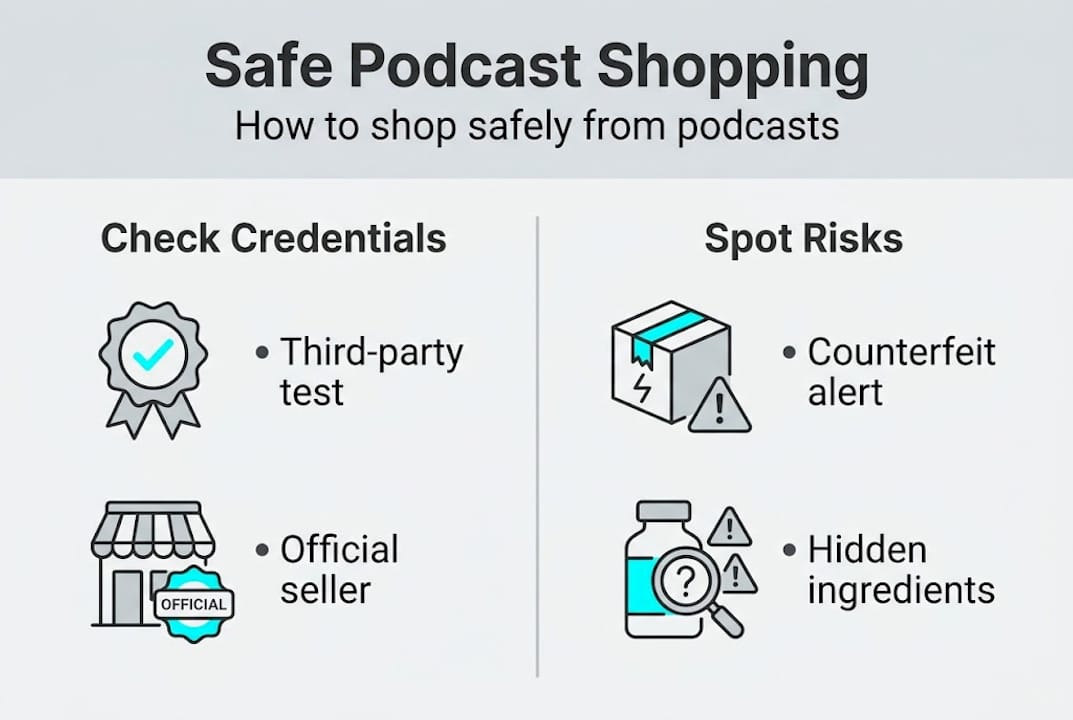
- Always verify supplement safety with third-party testing and certification databases before buying.
- Be cautious of counterfeit products by checking seller credibility and comparing packaging details.
You’re mid-run, earbuds in, and your favorite host just raved about a protein supplement that “changed everything.” You pause, pull out your phone, and start searching. Sound familiar? Podcast listeners are hit with product recommendations constantly, and the trust we place in hosts makes us uniquely vulnerable. The problem is that being mentioned on a podcast doesn’t make a product safe, tested, or even worth the price. This guide breaks down exactly how to shop smarter from podcast recommendations, spot the red flags, and use proven safety frameworks so you never waste money or risk your health on a bad buy.
Table of Contents
- How podcasts influence shopping choices
- Spotting safe versus unsafe products: Podcast techniques
- Avoiding counterfeit and unsafe items: Trusted advice
- Personal care products: Podcast methods for ingredient safety
- Why podcast safety solutions aren’t one-size-fits-all
- Discover curated safe products and podcast moments
- Frequently asked questions
Key Takeaways
| Point | Details |
|---|---|
| Podcast recommendations need scrutiny | Don’t assume products featured on podcasts are safe or high-quality—evaluate claims carefully. |
| Third-party testing is essential | Check for certifications like NSF or Informed Sport to verify the safety of supplements and promoted products. |
| Counterfeit risks are real | Beware of knockoff products by confirming seller legitimacy and examining trademarks and customer reviews. |
| Personal care safety is nuanced | Audit ingredients and prioritize swaps for those of concern rather than relying solely on podcast endorsements. |
| Balancing evidence and values | Tailor safety strategies to your own priorities, recognizing that scientific advice evolves and risks may be debated. |
How podcasts influence shopping choices
Podcasts have quietly become one of the most powerful shopping channels out there. Think about it: you’re spending 45 minutes to an hour with a host who feels like a friend. They share their morning routine, their workouts, their gear. And then they casually drop a product name. That’s not an ad in the traditional sense. That’s a personal endorsement from someone you’ve been listening to for months, maybe years.
This trust is genuinely powerful. It’s also where things get complicated.
Here’s what makes podcast shopping different from, say, seeing a banner ad online:
- Authenticity feels built in. Hosts speak in their own voice. Even paid sponsorships often get delivered in a conversational, personal style that blurs the line between genuine recommendation and paid promotion.
- You’re often multitasking. When you’re driving or working out, you’re not in critical-thinking mode. Claims slip in without being questioned.
- There’s no visual disclaimer. On YouTube or Instagram, sponsored content has labels. In your ears, a 30-second ad read can feel exactly like unprompted advice.
- Expert framing amplifies trust. If a host has a PhD or is a professional athlete, listeners often assume product endorsements carry the same credibility as their other insights. They often don’t.
“Just because a product is promoted on a podcast you love doesn’t mean it’s been independently tested, regulated, or proven to do what the host claims it does.”
NPR’s Life Kit offers practical criteria for judging whether marketing claims and so-called deals are actually good quality and good value. The framework they suggest involves asking: Is this claim specific and measurable? Is the source disclosing any financial relationship? Are there independent reviews outside of the podcast ecosystem?
These questions are simple, but most listeners never think to ask them in the moment.
The gap between “my favorite host loves it” and “this product is actually safe and effective” is real, and it’s wide. Making smarter product choices starts with recognizing that the podcast medium, as much as we love it, is not a consumer protection agency. It’s a content distribution platform with monetization built in.
So what does this mean practically? It means you need your own framework. Not cynicism, just a useful filter you apply before hitting “add to cart.”
Spotting safe versus unsafe products: Podcast techniques
Once you understand how podcast influence works, the next step is knowing how to evaluate what you’re actually being sold. This matters most in the supplement space, where the marketing can be loud and the regulation is quietly minimal.
Here’s something that genuinely surprises a lot of people: the FDA does not approve dietary supplements before they go to market. Brands can sell products without proving they work or even that they’re safe. The burden shifts to the consumer to figure it out. That’s a significant gap, and podcast ads rarely mention it.
Third-party testing is your best defense, according to supplement-safety methodology discussed on the Uphill Athlete podcast. The experts there specifically recommend looking for NSF International or Informed Sport certifications, which verify that a product contains what it claims and isn’t contaminated with banned substances.
Here’s how to actually do this before you buy:
- Search the product name in the NSF Certified for Sport database at nsfsport.com. If it’s listed, the batch has been independently tested.
- Check Informed Sport’s verified products list at informed.sport. This is especially important for athletes subject to drug testing.
- Look for a certificate of analysis (COA) on the brand’s website. Reputable companies post these publicly. If you can’t find one, ask.
- Cross-check the ingredients list against known safety databases like Examine.com, which compiles evidence-based research on supplements without brand affiliations.
- Search “[product name] + lawsuit” or “[product name] + recall” to check for any regulatory red flags in recent years.
This might feel like a lot of work for a protein powder, but it takes about five minutes and can save you from products that are mislabeled, underdosed, or contaminated.
Here’s a quick comparison of what certified versus uncertified products typically look like:
| Feature | Certified product | Uncertified product |
|---|---|---|
| Third-party testing | Yes, documented | Absent or self-reported |
| COA available | Publicly posted | Rarely shared |
| Ingredient accuracy | Verified | Unverified |
| Contamination screening | Tested | Unknown |
| Regulatory history | Clean or disclosed | Often unchecked |
For informed supplement shopping, this table is your starting point. If a podcast-recommended product fails on multiple rows, that’s a meaningful signal to slow down and research further.
Pro Tip: Bookmark the NSF and Informed Sport databases on your phone. Next time a host mentions a supplement mid-episode, you can check the certification before the episode ends. Quick wins like that are what separate reactive buyers from genuinely informed ones. You can also explore health and fitness podcast insights to see which products consistently come up across multiple trusted shows, which is itself a useful quality signal.
Avoiding counterfeit and unsafe items: Trusted advice
Safe products don’t just mean products that work. They also mean products that are actually what they claim to be. Counterfeits are a growing problem in online shopping, and podcast-driven purchases are not immune.

When a host recommends a product, listeners often search for it on platforms like Amazon or third-party discount sites. That’s where things get risky. A listing might use the right brand name and images, but the product inside could be counterfeit, expired, or entirely different. This isn’t a rare edge case. It’s a documented pattern that affects everything from electronics to skincare to supplements.
A Life Kit episode specifically addresses how to avoid counterfeits when shopping online, noting that knockoffs can be genuinely dangerous, not just disappointing. The episode walks through what to look for and where the biggest risks are concentrated.
Here are the clearest warning signs to watch for:
- Prices that seem too good to be true. A heavily discounted version of a premium brand on a third-party site is a red flag, not a deal.
- Missing or inconsistent trademarks. Compare the packaging carefully against images on the official brand website. Small differences in fonts, logos, or spelling are common in fakes.
- No brand storefront. On Amazon, check if the seller is the brand itself or an unverified third party. Unauthorized sellers frequently list counterfeits.
- Suspiciously generic reviews. Clusters of five-star reviews posted within days of each other, with no detail, are a classic sign of manipulation.
| Feature | Legitimate product | Counterfeit product |
|---|---|---|
| Seller type | Official brand or authorized retailer | Unknown third party |
| Trademark and logo | Consistent with brand standards | Slightly off or inconsistent |
| Price point | Standard retail pricing | Unusually discounted |
| Review pattern | Spread out, detailed, mixed | Clustered, generic, inflated |
| Product packaging | Matches official images exactly | Subtle differences in design |
Pro Tip: Always buy directly from the brand’s official website or from retailers the brand explicitly recommends on their site. Podcast hosts often include direct links in episode show notes, and those links typically go to the right place. Use them. If a show notes link redirects you somewhere unfamiliar, go directly to the brand’s URL instead. You can also track health podcast product trends to see which brands are consistently mentioned across reputable shows, which gives you a baseline for what’s legit and what might be an imitation.
This is about protecting yourself, not just getting the best deal. A counterfeit supplement isn’t a bargain. It’s an unknown substance in a branded package.
Personal care products: Podcast methods for ingredient safety
Supplements and counterfeits are obvious safety concerns. Personal care products feel more benign. But this is exactly where a lot of podcast listeners get caught off guard, because the risk here is real and the advice from hosts can sometimes be more alarming than helpful.
Here’s the reality: certain ingredients in personal care products have raised legitimate safety questions. Fragrances, phthalates, parabens, and formaldehyde-releasing preservatives are all ingredients that various health authorities and researchers have flagged for further scrutiny. But “flagged for scrutiny” is not the same as “proven dangerous.” The FDA’s position on many of these ingredients is nuanced, and the science is still evolving.
NPR’s Life Kit recommends a prioritization audit rather than throwing out everything in your bathroom cabinet. The methodology involves identifying products you use most frequently and at the highest concentration, since daily, full-body exposure matters more than occasional contact. Then you make targeted swaps for ingredients of concern in those high-exposure products first.
Here’s how to do your own personal care product audit:
- List the products you use every single day. Think moisturizer, deodorant, shampoo, body wash. These get the most attention first.
- Check the ingredients list on EWG’s Skin Deep database (ewg.org/skindeep), which rates ingredients based on available evidence.
- Flag products containing synthetic fragrances or phthalates. These are among the most common ingredients associated with potential hormone disruption concerns.
- Prioritize swaps based on use frequency and skin surface area. A full-body lotion used daily matters more than a weekly hair mask.
- Replace flagged products one at a time. You don’t need to overhaul everything at once.
The ingredients worth keeping on your radar:
- Synthetic fragrances: Often a catch-all term that can contain dozens of unlisted chemicals
- Phthalates: Used in fragrances and as plasticizers; associated with endocrine disruption concerns
- Parabens: Common preservatives that some studies link to hormonal effects at high exposures
- Formaldehyde-releasing agents: Found in some shampoos and straightening treatments
- Oxybenzone: A sunscreen chemical with ongoing regulatory debate
For nutrition and fitness expert podcasts, this kind of ingredient-level conversation is increasingly common, which is a genuinely good development. But remember: a host mentioning that an ingredient “can cause harm” is not the same as definitive evidence of harm at typical consumer exposure levels. Context matters.
Why podcast safety solutions aren’t one-size-fits-all
Here’s a take that might push back against some of what you’ve heard on your favorite episodes. A lot of podcast safety advice is excellent. It’s evidence-informed, practical, and often comes from genuine experts. But some of it leans toward absolutism, and that’s where I think listeners can get led astray.
“Never buy anything with fragrance.” “Throw out all your plastic.” “Only eat certified organic.” These sound like clear, helpful rules. In practice, they can create unnecessary anxiety and push people toward expensive alternatives that don’t offer meaningfully better safety outcomes.
Life Kit frames ingredient safety as a matter of ongoing evidence and personalized, prioritized risk decisions, rather than hard-line avoidance. That framing is exactly right. Science evolves. What’s flagged today may be cleared tomorrow. What looks safe now may be revisited. The goal isn’t to achieve perfect purity. It’s to make thoughtful decisions that align with your own risk tolerance and your actual exposure patterns.
Your safety strategy should fit your life. Follow podcast healthy habits that work for you, not someone else’s rigid protocol. The best approach is informed flexibility, not fear.
Discover curated safe products and podcast moments
Knowing the safety frameworks is great. Finding the right products to apply them to is where Prodcast comes in.

Prodcast analyzes thousands of podcast transcripts to surface the products hosts actually talk about, complete with the context behind each mention. So instead of trying to remember what was said halfway through a two-hour episode, you get the moment, the claim, and the product all in one place. Browse podcast moments to find the exact clips where your favorite hosts discuss products. Or explore trending items like the Game Changers product that keeps showing up across multiple shows. Smart shopping starts with knowing what the conversation actually said.
Frequently asked questions
How can I check if a podcast-recommended product is actually safe?
Look for third-party certifications like NSF or Informed Sport, which verify a supplement’s contents and screen for contaminants, since the supplement market has minimal FDA oversight before products reach shelves.
What are the top signs of counterfeit or unsafe products when shopping from podcast links?
Knockoffs can be dangerous, so watch for suspiciously low prices, inconsistent trademarks, unverified third-party sellers, and clusters of generic five-star reviews that appeared within a short timeframe.
Is it safe to use personal care products just because they’re recommended on a podcast?
No. Always audit the ingredients yourself using tools like EWG’s Skin Deep database, and prioritize swapping out high-exposure products that contain ingredients of concern rather than trusting any single recommendation.
Are all podcast hosts credible sources for product safety?
Not always. Hosts may lack scientific credentials or be financially tied to the brands they recommend, so treat podcast endorsements as a starting point for research rather than a final verdict on safety or quality.