CATEGORIES
TAGS
Unlock podcast metrics to drive better brand engagement

TL;DR:
- Focus on listener retention and engagement metrics rather than just download counts.
- Analyzing audience behavior and content response leads to more effective podcast advertising.
- Data-driven insights help brands optimize messaging, timing, and niche targeting for better results.
Most marketers think podcast success is a numbers game. More downloads equal more impact, right? Not quite. The brands quietly winning with podcast advertising aren’t obsessing over raw listener counts. They’re digging into the data underneath: who stayed through the whole episode, which segment made listeners pause, and what product mention sent traffic spiking. That’s where the real gold is. This article walks you through the podcast metrics that actually move the needle, how to read them like a pro, and how to use them to put your brand in front of the right ears at exactly the right moment.
Table of Contents
- Why podcast metrics matter for brand growth
- The essential podcast metrics every marketer should track
- How to analyze podcast data for actionable insights
- Applying podcast metrics to boost product promotion
- What most marketers miss about podcast metrics
- Take the next step with podcast metrics
- Frequently asked questions
Key Takeaways
| Point | Details |
|---|---|
| Metrics go beyond downloads | Tracking listener retention and engagement reveals campaign effectiveness, not just reach. |
| Data drives niche targeting | Segmented podcast analytics help brands target and engage specific audience groups. |
| Actionable insights fuel product promotion | Turn podcast data into practical strategies for boosting product visibility and conversion. |
| Engagement trumps vanity numbers | Focusing on listener behavior delivers better results than chasing high download counts. |
Why podcast metrics matter for brand growth
Podcast advertising has grown up. It’s not enough to slap a mid-roll ad into a popular show and hope for the best. Today, the brands getting real traction are the ones using data to make smarter decisions. And there’s a lot of data to work with.
Here’s the thing: audience engagement insights reveal actionable data for marketers beyond just total downloads. That means listener behavior, topic affinity, drop-off patterns, and content preferences are all on the table. You just need to know where to look.
Why does this matter for brand growth specifically? Because podcasts are intimate. Listeners aren’t passively scrolling. They’re tuned in during their commute, at the gym, or cooking dinner. That kind of undivided attention is rare in marketing. When a trusted host recommends your product in that context, the impact is massive.
Consider these core reasons why smart marketers are leaning into podcast metrics:
- Audience demographics: Podcast platforms now give you detailed listener profiles. Age, location, device type, and even income bracket are often available.
- Engagement rate: This tells you how actively listeners are responding to content, including sharing, replaying, and clicking linked show notes.
- Listener retention: Are people staying through the full episode, or bailing at the five-minute mark? This shapes where you place your brand mention.
- Topic relevance: Metrics tied to episode topics help you identify which content themes attract your ideal buyer.
- Listener growth trends: A show with steady audience growth is often a better long-term bet than one with a massive but stagnant base.
“The podcasts with the most loyal audiences aren’t always the biggest ones. They’re the ones where listeners feel genuinely connected to the host. That loyalty transfers to every brand mentioned.”
With podcast engagement strategies, the data gets even more compelling. 58% of Americans now listen to podcasts, and that audience is growing year over year. But raw size isn’t the story. It’s the depth of connection that separates a good podcast placement from a great one.
Now that you understand the real power behind podcast metrics, let’s dive deeper into which numbers matter most.
The essential podcast metrics every marketer should track
Understanding why metrics matter sets the stage for identifying the specific numbers that drive results. Not all data points are created equal, and tracking the wrong ones wastes time and budget.
Here are the metrics you actually need to care about:
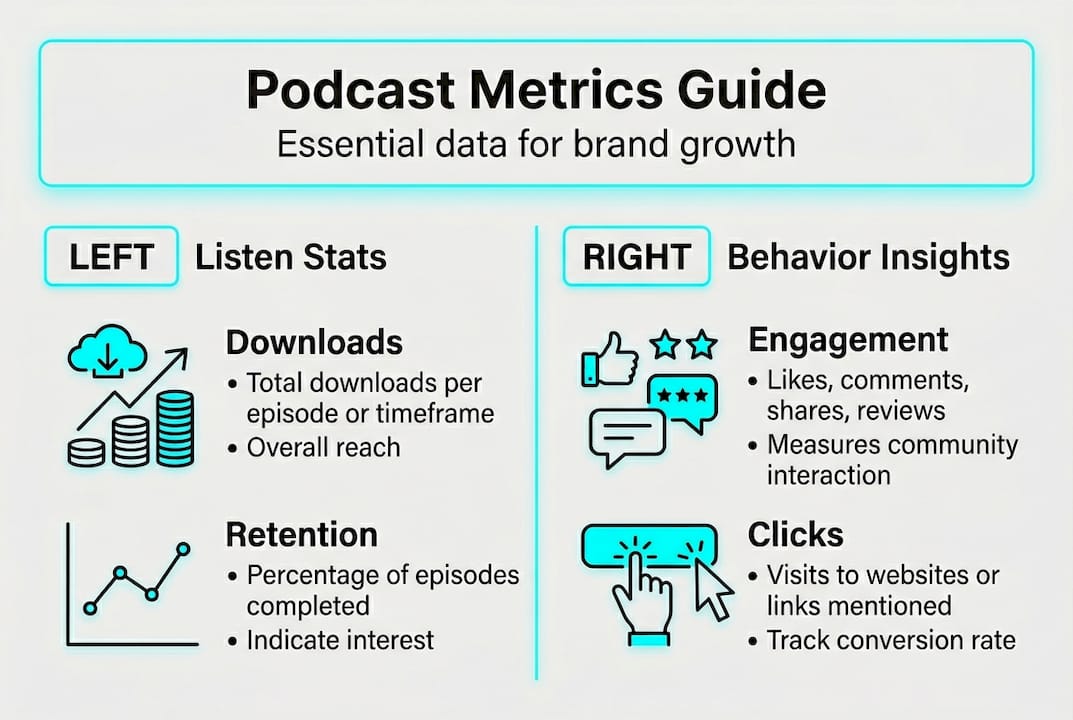
- Downloads per episode: Your baseline. It tells you reach, but not much else on its own.
- Listener retention rate: The percentage of each episode that listeners actually complete. A retention rate above 70% is strong.
- Engagement rate: Shares, comments, click-throughs on show notes, and listener responses to calls to action.
- Demographic breakdown: Who is listening? Age, gender, location, and device data help you assess audience fit.
- Episode-specific spikes: Sudden jumps in listens tied to a specific episode can signal which topics resonate most with the audience.
Here’s a quick comparison to keep things clear:
| Metric | What it measures | Why it matters for campaigns |
|---|---|---|
| Downloads | Total episode reach | Sets baseline audience size |
| Engagement rate | Listener interaction depth | Shows how invested the audience is |
| Retention rate | Completion percentage | Reveals where attention drops off |
| Demographics | Audience profile data | Helps align your product with real buyers |
As the data shows, marketers need to track more than downloads. Retention and engagement are key to understanding whether your message is actually landing.
To analyze campaign effectiveness step by step:
- Pull episode-level data for the past 90 days.
- Identify which episodes have the highest retention rates.
- Cross-reference those episodes with topic categories and guest types.
- Look at which episodes drove external traffic or product inquiry spikes.
- Use those patterns to guide your next placement decision.
Pro Tip: Don’t just track your metrics weekly. Look for month-over-month trend lines. A single spike is noise. A consistent climb in retention or engagement is a signal worth acting on. Tools focused on boosting audience engagement can help automate this kind of trend spotting so you’re not doing it manually.
There are also platforms built specifically around podcast metrics strategies that make the whole process faster. Worth exploring before you build another spreadsheet from scratch.

How to analyze podcast data for actionable insights
Once you know which metrics to track, the next step is turning your raw data into actionable insights. Numbers without interpretation are just noise.
Most analytics dashboards, whether you’re working inside Spotify for Podcasters, Apple Podcasts Connect, or a third-party tool, surface the same core data. The skill is knowing what patterns to look for.
Here are the most common patterns and what they mean:
- Early drop-off (first 10%): Intro is too long or not engaging enough. Listeners tuned out before the meat of the episode.
- Mid-episode spike in replays: Something was said that made people rewind. That’s a golden nugget. A product mention here is prime real estate.
- Drop-off after a specific segment: The content or the guest didn’t land. Avoid placing your brand in similar segments.
- Consistent high retention over multiple episodes: The host has strong audience trust. A great sign for brand alignment.
- Sudden listener growth on a specific episode: The topic went broader than usual. Worth analyzing for content and promotional opportunities.
Here’s a simple data visualization to guide your trend analysis:
| Pattern observed | Likely cause | Recommended action |
|---|---|---|
| Early drop-off | Weak opening | Shift ad placement to later in episode |
| Mid-episode replay spike | Highly engaging moment | Target that segment for brand mentions |
| Post-episode traffic surge | Strong call to action | Replicate the CTA format in future campaigns |
| Audience demographic shift | New topic or guest type | Reassess audience fit for your product |
Effective analysis of podcast data leads to higher audience growth, and that growth compounds when your promotional strategy is aligned with what listeners actually want to hear.
Pro Tip: Segment your audience insights by episode theme rather than just show name. A business podcast might have episodes skewing toward solopreneurs one week and enterprise leaders the next. Your product message needs to flex accordingly. Data-driven audience growth starts with that kind of nuanced segmentation.
You can also tap into podcast insight strategies to benchmark your analysis against broader industry trends, which is especially useful when you’re entering a new podcast niche.
Applying podcast metrics to boost product promotion
With actionable insights in hand, it’s time to connect the dots and leverage metrics for product promotion. This is where the rubber meets the road.
Successful product promotion through podcasts isn’t about buying the most ads. It’s about placing the right message in the right context at the right time. And metrics tell you exactly when and where that is.
Here’s a step-by-step approach to campaign planning based on podcast data:
- Identify your best-fit shows: Use demographic and topic data to shortlist podcasts where your audience already hangs out.
- Analyze retention patterns: Find the exact episodes where listener attention peaks. That’s your window.
- Match your message to the moment: If a show’s highest-retention episodes cover productivity tools, and you’re promoting a project management app, that’s a fit.
- Set a testing window: Run your promotion across three to five episodes and compare engagement rate and traffic spikes before scaling.
- Iterate based on results: If one episode outperforms the rest, dig into what made it different. Was it the host’s delivery? The topic? The timing?
“The brands that win in podcast advertising treat every campaign like a learning lab. Each placement gives you more data to make the next one sharper.”
Niche targeting is where Spotify podcast analytics really shines. Brands use podcast insights to refine promotion tactics and campaign timing, and Spotify’s platform gives you granular listener data that most other sources can’t match. You can see not just who’s listening, but when and for how long.
Pro Tip: Adapt your messaging for your highest-performing audience segments rather than running a single generic script. A supplement brand speaking to marathon runners in a fitness podcast should sound completely different from the same brand targeting casual gym-goers on a lifestyle show. The data tells you which version to use where.
What most marketers miss about podcast metrics
Here’s a hard-won truth: most marketers are still chasing vanity numbers. Downloads feel tangible. They’re easy to report upward. But they tell you almost nothing about whether your audience is actually connecting with your brand.
The real signal is in listener behavior. Someone who completes 90% of an episode and then clicks a show notes link is worth ten times more to your campaign than someone who downloaded the episode and never played it. That distinction is huge, and most campaign briefs ignore it entirely.
Niche audiences also outperform broad ones in almost every promotion scenario. A show with 8,000 loyal, engaged listeners in a specific industry will move more product than a show with 80,000 passive subscribers who stumbled in from a celebrity guest episode.
Data-driven promotions also build brand loyalty in a way that broad advertising rarely does. When your brand shows up in a trusted host’s recommendation, within a context the listener already cares about, it feels like a referral from a friend. That’s the kind of brand impression that sticks.
Focus on growing podcast audiences through engagement, not just reach. The brands that figure this out early are the ones building durable relationships with niche consumer communities. Everyone else is just buying attention that evaporates after the episode ends.
Take the next step with podcast metrics
Ready to harness podcast metrics for your next campaign? Prodcast makes it easy.

Prodcast is built for marketers who are done guessing. The platform analyzes thousands of podcast transcripts to surface real product mentions, high-engagement moments, and audience behavior patterns across every major niche. Instead of scrubbing through hours of audio trying to find the good stuff, you get structured, searchable insights delivered fast. Explore Podcast Moments to discover exactly when and where your category comes up in conversation. Or check out Mass Persuasion to run targeted campaigns aligned with the podcast audiences already primed to care about what you sell.
Frequently asked questions
Which podcast metrics are most important for product promotion?
Retention and engagement drive campaign effectiveness. Listener retention, engagement rate, and audience demographics are most critical for optimizing product promotion.
How can brands track podcast metrics easily?
Brands can use analytics dashboards and tools like Prodcast to monitor and visualize key podcast numbers. Prodcast offers dashboards built specifically for marketers who need clarity fast.
What’s the difference between downloads and engagement rate?
Downloads measure initial reach, while engagement rate indicates how actively listeners interact with episodes and content. Engagement shows involvement that downloads simply can’t capture.
Can podcast metrics help target niche audiences?
Yes. Segmenting analytics by demographics and interests lets brands create highly relevant promotions for niche groups. Podcast insights allow targeting that generic ad platforms can’t match.
How do you turn podcast data into actionable marketing strategies?
Identify high-performing segments, adapt messaging, and use metrics to refine campaign timing and placement. Data-driven adjustments consistently improve marketing outcomes when applied consistently over time.
Recommended
- Podcast Engagement Metrics: What Brands and Listeners Nee… | Prodcast
- Boost podcast audience engagement with proven data insights | Prodcast
- Boost podcast audience engagement with proven data insights | Prodcast
- Unlock podcast product discovery with data-driven strategies | Prodcast
- Music marketing workflow for hip-hop artists in 2026