CATEGORIES
TAGS
User generated podcast content: a producer’s guide
TL;DR:
- AI has enabled the rapid creation of diverse user generated podcast content, including AI-driven episodes and community submissions. This format fosters deeper audience engagement and offers significant monetization opportunities through trust-based host-read ads and platform-specific strategies. Effective integration requires securing permissions, balancing automation with human oversight, and leveraging tools to highlight shareable moments for growth.
AI made a podcast. It processed over 3 million documents, generated lifelike narration, and pulled in over 2 million downloads. No human host. No studio. That’s the world of user generated podcast content today, and it’s moving faster than most producers realize. If you’re trying to figure out where audience-driven formats fit into your engagement and monetization strategy, this guide breaks down exactly what’s working, what the data says, and how to apply it.
Table of Contents
- Understanding user generated podcast content: types and emergence
- Data-driven insights on audience growth and engagement
- Monetizing user generated podcast content effectively
- Best practices for incorporating listener-generated audio content
- Leveraging AI technology for personalized and scalable podcast content
- Reimagining user generated podcast content: the new frontier for authentic engagement
- Enhance your podcast with Prodcast’s user-generated content tools
- Frequently asked questions
Key Takeaways
| Point | Details |
|---|---|
| User generated podcast types | Includes AI-generated shows, listener voicemails, and community-driven content that broaden podcast formats. |
| Audience growth data | Top podcasts use multi-channel strategies, with new listeners showing stronger purchase intent. |
| Monetization tactics | Host-read mid-roll ads deliver higher engagement and premium CPMs, key for user content episodes. |
| Listener content best practices | Obtain explicit permissions and set quality standards when incorporating listener audio. |
| AI-powered scalability | AI helps rapidly produce personalized and niche content but requires human editorial oversight. |
Understanding user generated podcast content: types and emergence
So what actually counts as user generated podcast content? The definition is broader than most people expect.
It’s not just a listener calling in with a question. It covers AI-scripted episodes built from public data, crowdsourced podcast ideas shaped by community votes, listener voicemails woven into episode segments, and full fan-created podcast episodes where the audience essentially becomes the creative team. The umbrella is wide, and that’s actually good news for producers.
The clearest recent example of how far this has come is The Epstein Files, an AI-generated podcast that achieved over 2 million downloads by synthesizing publicly available documents into coherent audio narratives. No human journalist scripted those episodes. A machine did the heavy lifting.
On the production side, tools like Podbean’s AI creator now let anyone convert text or URLs to episodes in minutes, complete with custom voices and music. That’s a genuine shift. Niche shows that used to require a full production team can now launch with a single person and a clear idea.
Here’s a quick breakdown of the main forms this content takes today:
- AI-driven narrative episodes: Fully scripted and voiced by AI, often from data or public documents
- Listener audio submissions: Voicemails, voice notes, or recorded responses edited into episodes
- Community-sourced podcast segments: Topics, questions, or story angles submitted by listeners and shaped by the host
- Interactive podcast storytelling: Branching narratives or live voting formats where audience input changes the episode direction
- Fan-created podcast episodes: Entire episodes produced by listeners, sometimes within a brand’s format framework
The thread connecting all of these is user involvement in podcasts at a level that was technically difficult or expensive just a few years ago. Understanding ai in podcasting as a production tool, not just a novelty, is what separates producers who grow from those who watch others grow. Smart use of audience engagement strategies is what makes the difference.
Data-driven insights on audience growth and engagement
The numbers behind audience-driven podcast formats are hard to ignore right now.
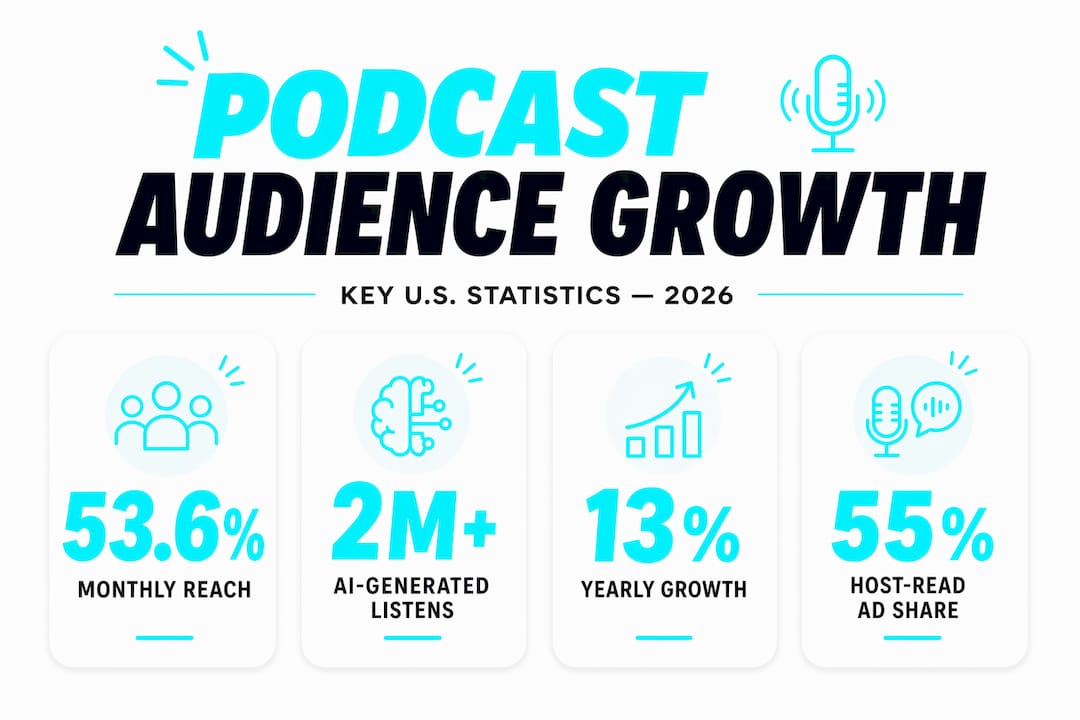
Podcasting reaches 53.6% of the U.S. population monthly. That’s not a niche medium anymore. And the listeners coming in fresh are particularly valuable. New podcast listeners show stronger purchase intent across four key brand categories, which means formats that attract first-time listeners carry real monetization upside.
Podtrac’s March 2026 data shows top publishers reporting double-digit unique monthly audience growth, with much of that driven by video clips distributed across Instagram, TikTok, and YouTube. The clip economy is real. Short, shareable moments from collaborative podcast content are pulling new listeners into full episodes.
Here’s how the growth picture breaks down across key platforms:
| Platform | Content format driving growth | Audience behavior |
|---|---|---|
| TikTok | Short listener reaction clips | Discovery, high share rate |
| Instagram Reels | Host + listener highlight moments | Community engagement |
| YouTube | Full video episodes + clips | Deeper watch time, subscriptions |
| Podcast apps | Full-length community-sourced episodes | Loyal listening, higher completion |
The platforms driving the biggest new-listener numbers are the same ones where community-sourced podcast content travels fastest. A listener who submits a voicemail that gets clipped and shared on TikTok becomes an organic promoter. Their followers follow them in.
Key audience growth drivers to track:
- Clip shareability: Are your listener-generated moments short and punchy enough to stand alone?
- Comment-to-episode conversion: How many social interactions translate to full episode plays?
- New vs. returning listener ratio: A healthy mix signals that collaborative formats are pulling in fresh audiences
- Completion rate on community episodes: This tells you if the format actually holds attention
Pro Tip: Use your episode completion data to evaluate which types of listener contributions keep audiences listening longest. Voicemail-heavy segments sometimes outperform expert interviews because the audience hears themselves in the content.
For more on this, check out our breakdown of how to grow podcast audience using data-driven insights and what the numbers actually reveal about podcast engagement strategies.
Monetizing user generated podcast content effectively
Growth is great. Revenue is better. So how do you turn an audience-driven podcast into a monetized one without killing the vibe that made people show up?
The ad format that dominates podcast revenue right now is host-read. Host-read ads account for 55% of all podcast ad revenue, and niche shows command CPM rates of $25 to $50. That’s meaningful money, especially when you’re running a community-sourced podcast where the audience already trusts the voice delivering the content.
Placement matters as much as format. Mid-roll ads deliver 25 to 50% higher engagement rates than pre-roll placements, making them the obvious choice for listener-generated audio episodes where retention peaks mid-episode.
A few things to keep in mind when monetizing user-involved episodes specifically:
- Authenticity of the read: If a listener’s voicemail leads into an ad, the transition needs to feel organic, not jarring
- Segment timing: Place mid-rolls after a particularly engaging listener contribution, not in the middle of one
- Transparency with contributors: If a listener’s audio appears in a monetized episode, tell them. It builds trust and repeat contributions
- Sponsor alignment: Match ad categories to the community’s interests. A fitness community-sourced podcast with a supplement sponsor makes sense. Misalignment kills credibility fast.
- Dynamic ad insertion: For older episodes with high listener-generated content, dynamic insertion lets you monetize backlog without re-recording
Pro Tip: When sponsors hear that an episode features real listener voices, they often respond positively because it signals an active, invested audience. Use that as a selling point in your media kit.
The key is finding the balance. Listeners who contribute to an episode feel ownership over it. Overloading that episode with ads can feel like you’re cashing in on their trust. One or two well-placed, relevant mid-rolls is usually the sweet spot. Learn more about how to boost podcast listener engagement while keeping monetization clean.
Best practices for incorporating listener-generated audio content
Getting listener audio into your show sounds simple. In practice, there are several steps worth getting right from the start.
Explicit permissions must be secured before publishing, editing, or repurposing any listener-submitted audio. That means not just a general disclaimer in your bio, but a clear agreement at the point of submission. Here’s a practical step-by-step process:
- Set up a dedicated submission channel. Use a voicemail service, a voice recording app, or a web form that captures audio files. Patch it directly to your editing workflow.
- Include permission language at submission. A short checkbox or statement like “I agree that my submission may be used, edited, and published by [Show Name]” covers the basics.
- Define your audio quality threshold. Send contributors a simple guide: record somewhere quiet, hold your phone six inches from your mouth, speak clearly. You’d be surprised how much this improves raw submissions.
- Screen before you edit. Listen to all submissions before putting anything in the timeline. Not every clip is usable, and some may contain sensitive or off-brand content.
- Edit for length and flow. Listener audio almost always needs trimming. Cut filler words, reduce background noise, and normalize volume levels to match your show’s standard.
- Credit contributors clearly. Name them (with permission), acknowledge their contribution, and make it feel like a moment in the episode rather than an afterthought.
Pro Tip: Keep a short response template ready to send to contributors whose audio you didn’t use. Thank them genuinely and invite them to submit again. The ones who feel valued come back and become your most loyal promoters.
Listener-generated audio does something a host can’t replicate. It proves the community exists. When new listeners hear a real person’s voice in an episode, it shifts the show from monologue to community. That shift is worth the extra editing work. Explore more on how these practices connect to broader podcast engagement strategies user audio.
Leveraging AI technology for personalized and scalable podcast content
Here’s where things get genuinely interesting and a little complicated.
AI can produce episodes faster than any human team. It can process thousands of documents, identify relevant storylines, script compelling narratives, and voice them in minutes. That’s the promise. The reality requires a bit more nuance.

The Washington Post’s AI-personalized podcast took six months to refine using internal scoring algorithms that evaluated accuracy, tone, and audience engagement together. That’s not a weekend project. Getting AI-generated podcast content to a publishable standard requires real editorial investment upfront.
Meanwhile, The Epstein Files demonstrated that AI can produce coherent narratives quickly but without editorial oversight, trust and accountability become serious concerns. The content sounded credible. It wasn’t always accurate. That gap matters enormously for producers whose audiences rely on them for reliable information.
Here’s a side-by-side comparison to help you think through the tradeoffs:
| Factor | AI-generated content | Human-created content |
|---|---|---|
| Production speed | Minutes to hours | Days to weeks |
| Customization | High at scale | High but labor-intensive |
| Audio quality | Consistent, controllable | Variable, depends on talent |
| Editorial oversight | Limited without human review | Strong with experienced team |
| Audience trust | Building, context-dependent | Established over time |
| Cost at scale | Lower | Higher |
Best practices for integrating AI without losing integrity:
- Always have a human editor review AI-generated scripts before publishing
- Be transparent with your audience when AI tools contributed to an episode
- Use AI for production efficiency, not to replace editorial judgment
- Test AI voices with your specific audience before committing to a format
- Set clear internal rules about what AI can generate versus what must be human-written
AI content workflow efficiency can cut research time significantly, but speed without judgment is a liability. Dive deeper into ai in podcasting technology to see how producers are striking that balance today.
Reimagining user generated podcast content: the new frontier for authentic engagement
Here’s my honest take: the conversation about user generated podcast content often gets tangled in technology debates when the real question is simpler. Are your listeners becoming part of the story, or are they still just watching from the outside?
The Epstein Files is a useful case study precisely because it’s uncomfortable. It marks a moment where the cultural meaning of voice is tested, as synthetic voices replace human hosts and listeners start recalibrating what “authentic” even means in audio. That’s not a technology problem. It’s a trust problem.
And trust is built the same way it always has been: through consistency, genuine interaction, and letting your audience feel heard. Spotify’s Hodan Ismail puts it well, noting that treating social platforms as conversations with fans builds real audience investment and surfaces what people actually care about.
The shows doing this best aren’t choosing between AI efficiency and human warmth. They’re using both. Collaborative podcast content works when the automation handles the production grind and the human moments handle the connection. Shows like DNVR Nuggets, where fan contributions and community voting shape episode content, demonstrate that interactive podcast storytelling isn’t just a format gimmick. It’s a community ownership model.
The producers who get this right will build shows their audiences defend, share, and grow. Not because the audio sounds perfect, but because listeners feel like they’re part of something. That’s the real value of community-sourced podcast content, and no algorithm shortcut replaces it. Read more about how to boost podcast audience engagement insights with proven approaches.
Enhance your podcast with Prodcast’s user-generated content tools
You’ve now got a clear picture of how user generated podcast content drives growth, deepens engagement, and opens up new monetization paths. The next step is putting that into practice without spending hours hunting for the right clips or managing permissions manually.

Prodcast’s Moments tool makes it easy to discover the most shareable, high-impact clips from your episodes, including listener-contributed audio, and push them to social platforms in seconds. It’s built for producers who want to turn great podcast moments into audience growth without the manual clip-hunting grind. And if you’re looking to understand what products and ideas are actually resonating with your audience across your catalog, Prodcast’s Mass Persuasion gives you the data layer to act on it. Less scrubbing through audio. More time building the kind of community your listeners actually want to be part of.
Frequently asked questions
What exactly is user generated podcast content?
User generated podcast content includes any podcast audio created or contributed by listeners or AI tools, such as listener voicemails, AI-scripted episodes, or community-driven recordings where the audience shapes the show’s direction.
How can podcasters legally use listener-submitted audio?
Podcasters should obtain explicit permissions covering publishing and editing rights at the point of submission, and communicate clear audio quality requirements so contributors know exactly what they’re agreeing to.
Are AI-generated podcasts trustworthy?
AI-generated podcasts can rapidly process and narrate large amounts of data, but AI podcasts like The Epstein Files show that without human editorial oversight, accuracy and accountability gaps can weaken listener trust over time.
What are the best ad placements to monetize user generated podcast episodes?
Mid-roll ad placements yield 25 to 50% higher engagement than pre-rolls, making them the most effective option for monetizing listener-generated or community-driven episodes where audience attention peaks mid-episode.
How can podcasters engage with their audience using social platforms?
Treating social platforms as conversations rather than broadcast channels helps podcasters build genuine audience investment, surface what topics listeners care about most, and grow organically through direct fan interaction.