CATEGORIES
TAGS
Real benefits of ad-free podcasts for listeners
TL;DR:
- Higher ad volumes decrease listening time, engagement, and increase listener churn.
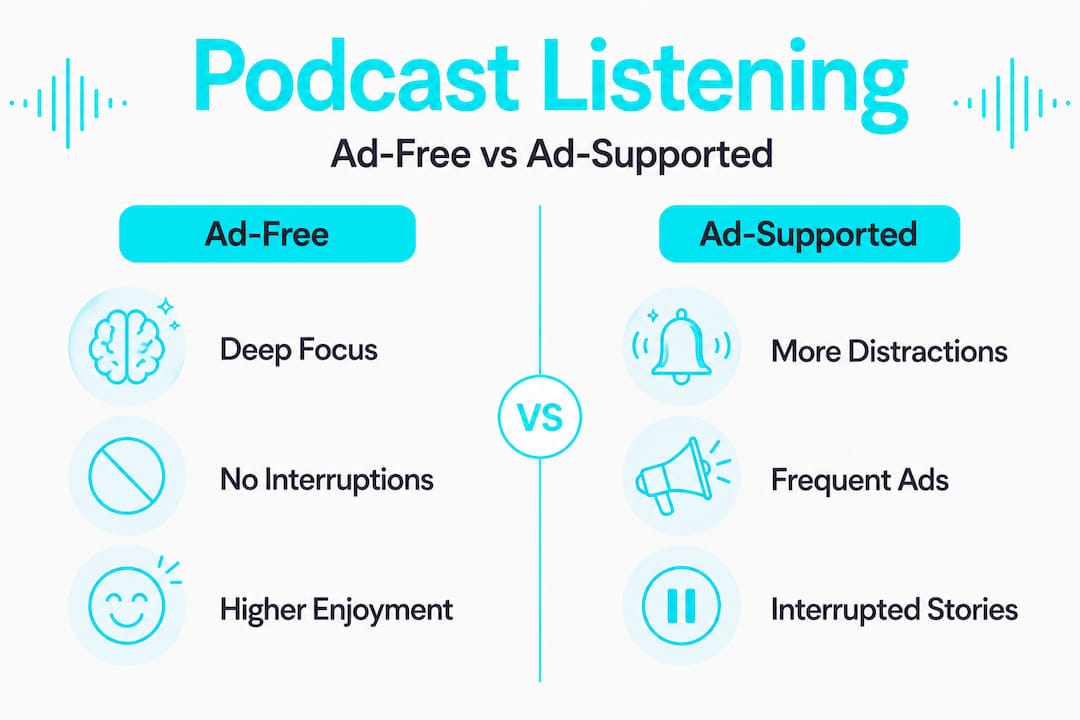
- Ad-free listening enhances focus, immersion, and overall enjoyment of podcasts.
- Creator memberships offer the most comprehensive and reliable ad-free podcast experience.
You hit play on a gripping true-crime episode, the narrator’s voice pulls you in, and then — a 60-second ad for a mattress brand jolts you right out of it. It feels like a minor annoyance, right? Turns out, it’s more than that. Ad-load sensitivity data shows that higher ad volumes actively drive listeners toward ad-free subscriptions, reduce time spent listening, and chip away at overall enjoyment. This guide unpacks exactly what the evidence says and why ad-free listening isn’t just a luxury — it’s a genuinely smarter way to experience podcasts.
Table of Contents
- Why ads disrupt the podcast experience
- The mental benefits of ad-free listening
- How ad-free podcasts are delivered: the methods and their limits
- Common myths and realities about ad-free podcasting
- Why ad-free feels different — what most experts overlook
- Try ad-free podcast moments with Prodcast
- Frequently asked questions
Key Takeaways
| Point | Details |
|---|---|
| Ad-free equals fewer interruptions | Ad-free podcasts help you focus and enjoy stories without constant disruption. |
| Behavior changes with ads | Too many ads lead listeners to tune out or seek premium content. |
| Immersion and mental clarity | Ad-free shows are proven to reduce cognitive fatigue and boost enjoyment. |
| Not all ad-free is created equal | Some ads remain even with premium plans, so know your options before subscribing. |
| Try ad-free podcasting easily | Discovery platforms let you sample ad-free moments and episodes instantly. |
Why ads disrupt the podcast experience
Let’s be honest. We’ve all told ourselves that ads are just part of the deal. You skip them when you can, zone out when you can’t, and carry on. But the data tells a different story.
Research from a large-scale Pandora experiment on ad-load sensitivity found that as the number of ads per hour increases, listening time drops, active listening days decrease, and users become measurably more likely to switch to ad-free options. This isn’t a gut feeling — it’s a behavioral pattern backed by real usage data from millions of listeners.
And it makes sense when you think about it. Podcasts, unlike background music, require active listening. Your brain is processing language, following arguments, and building emotional connections with the host. When an ad interrupts that, you don’t just pause and resume. You have to re-orient. You lose the thread. You might even feel slightly irritated, which colors how you feel about the whole episode.
“Annoyance from repeated ad interruptions doesn’t reset between episodes. It accumulates — and at some point, listeners stop tolerating it.”
Here’s what the research consistently shows about high ad-load environments:
- Reduced total listening time per session and per week
- Fewer active listening days, meaning people tune in less often
- Higher churn rates toward ad-free tiers or competitor platforms
- Lower content satisfaction scores, even when the content itself didn’t change
- Increased skip behavior, which ironically signals disengagement rather than engagement
You can dig further into how this shapes listener behavior by looking at audience engagement data across genres and formats. The patterns are remarkably consistent whether you’re listening to true crime, business interviews, or comedy. Ads at the wrong volume don’t just interrupt — they erode loyalty. And for listeners who’ve invested real time in following a show, that erosion feels personal. Understanding podcast ad effectiveness from the listener’s side of things helps explain why so many people are actively choosing to pay their way out of ad-supported feeds.
The mental benefits of ad-free listening
Once you accept that ads genuinely disrupt the experience, the next logical question is: what does uninterrupted listening actually do for you?
Quite a lot, it turns out.
A University of Washington study on cognitive fatigue found that ad-free apps and subscriptions provide uninterrupted immersion that directly reduces the cognitive load associated with frequent interruptions. That might sound technical, but think about what it means practically. When your brain isn’t constantly being pulled out of a story and asked to process a completely different brand message, it stays in a more focused, receptive state.
And the benefits compound. A Vox analysis of podcasts and attention highlights that ad-free listening actively enhances focus and narrative immersion, with potential improvements to attention span over time. That’s a meaningful finding in an era where short-form content has trained many of us to expect interruptions every few seconds.
Here’s a quick look at how ad-supported and ad-free listening environments compare on key mental and experiential metrics:
| Factor | Ad-supported listening | Ad-free listening |
|---|---|---|
| Cognitive interruptions | High (multiple per hour) | Minimal to none |
| Narrative immersion | Frequently broken | Sustained throughout |
| Content retention | Lower | Higher |
| Listener fatigue | Builds over time | Reduced significantly |
| Overall enjoyment | Moderate | Consistently higher |
| Attention span impact | Neutral to negative | Neutral to positive |
The recovery time problem is real. When your brain gets pulled out of focused listening by an ad, it doesn’t snap back instantly. Research on attention recovery suggests it can take anywhere from 23 seconds to several minutes to fully re-engage with complex content after a context switch. For narrative podcasts, interviews, or dense educational content, that lost time and mental energy adds up fast.
For multi-episode series or serialized storytelling, this matters enormously. If you’re tracking a nuanced investigation across six episodes, every ad break is a chance to lose the plot thread. Ad-free listening lets you stay inside the story.

Pro Tip: If you’re listening to educational or story-driven podcasts, try a single ad-free session and notice how differently you feel at the end. Most people are surprised by how much less mentally tired they feel compared to an ad-supported listen of the same length.
You can find great podcast immersion tips that help you get the most out of deep-listening sessions, whether you’re commuting, working out, or just winding down.
How ad-free podcasts are delivered: the methods and their limits
Okay, so you’re sold on the idea. But how do you actually get ad-free podcasts? And more importantly, what are you actually getting when you pay for or enable ad-free options?
There are three main delivery methods, and each comes with real-world tradeoffs worth knowing before you spend a dollar.
1. Premium platform subscriptions
Services like Spotify Premium remove platform-inserted ads from the listening experience. These are the ads that the platform itself injects into the audio feed — often pre-roll or mid-roll spots from major advertisers. But here’s the catch: ad-free subscription mechanics make clear that Spotify Premium and similar plans do not remove “baked-in” host reads. These are ads that the host recorded directly into the episode, often as part of their own monetization deal. They live in the audio file itself, not in the platform layer.
2. Open-source and third-party podcast apps
Apps like AntennaPod use dynamic ad detection algorithms to identify and skip ad segments automatically. According to published data on podcast ad-free mechanics, these tools detect and skip roughly 85 to 95 percent of ads successfully. That’s impressive, but not perfect. Baked-in reads and manually recorded sponsor segments often slip through because they’re indistinguishable from regular content at the audio level.
3. Dynamic Ad Insertion (DAI) control and creator-led memberships
Some creators offer their own ad-free RSS feeds through platforms like Patreon or Supercast. In these cases, you’re paying the creator directly, and the feed you receive genuinely has no ads, including host reads. This is often the cleanest ad-free experience available.
Here’s how those three options stack up:
| Method | Platform ads removed | Host-read ads removed | Cost | Reliability |
|---|---|---|---|---|
| Spotify Premium | Yes | No | Monthly subscription | High |
| AntennaPod (open-source) | Yes (85-95%) | Rarely | Free | Moderate |
| Creator-direct membership | Yes | Yes | Per creator | Very high |
| DAI auto-skip tools | Yes | Sometimes | Varies | Moderate |
The key takeaway? Know what you’re paying for. If a host’s enthusiastic personal recommendation for a brand is part of why you love the show, you might not want to skip it anyway. Understanding podcast revenue models helps clarify why some ads are baked in and why creators structure their monetization the way they do. And if you want the bigger picture on where the industry is heading, the coverage on ad-free trends in podcasting is worth a read.
Pro Tip: Before subscribing to any platform’s premium tier for ad-free listening, check whether your favorite shows use host-read ads. If they do, a creator-direct membership will give you a cleaner experience than a platform subscription alone.
The numbered steps for making a smart ad-free decision:
- List the podcasts you listen to most often
- Check whether they rely on dynamic ads, host reads, or both
- Choose your ad-free method based on which type of ads you encounter most
- Trial a single paid month before committing to an annual plan
- Reassess after 30 days — most people notice a real difference quickly
Common myths and realities about ad-free podcasting
There’s a lot of confusion out there about what ad-free actually means. Some of it comes from platform marketing. Some of it comes from wishful thinking. Let’s clear it up.
Myth 1: Ad-free subscriptions remove all ads
Not true. As we covered above, most platform subscriptions only remove dynamically inserted ads, not host-read content baked directly into the episode file. Baked-in reads are part of the audio itself, and no subscription tier can retroactively edit them out.
Myth 2: Going ad-free hurts creators
This one deserves nuance. When you use a platform skip tool without paying anyone, yes, creators lose ad revenue. But when you subscribe through a creator’s own membership platform, you’re often paying them more directly than they’d earn from ad impressions. Direct subscriptions cut out the middleman entirely.
Myth 3: Ads are just a minor inconvenience
We debunked this upfront, but it bears repeating. The sensitivity to ad load per hour is statistically significant. Listeners aren’t just mildly annoyed. High ad loads change behavior: they listen less, engage less, and leave for ad-free alternatives at measurable rates.
Myth 4: Ad-free podcasts are hard to find or access
Honestly, this might have been true five years ago. Today, options range from platform subscriptions to creator memberships to open-source apps. Exploring engagement strategies shows just how many listeners are already making the switch, especially as the creator economy matures and direct-support models become more mainstream.
Here’s a quick reality check on what ad-free genuinely does and doesn’t promise:
- It does give you a cleaner, more focused listening experience
- It does often support creators more directly than ad-supported listening
- It doesn’t always remove 100% of ads, especially host-read content
- It doesn’t require a massive monthly spend — many creator memberships cost just a few dollars
“Ad-free isn’t a binary. It’s a spectrum. The more directly you pay creators, the cleaner your experience tends to be.”
Why ad-free feels different — what most experts overlook
Here’s something most analysis of ad-free podcasting misses entirely. The conversation almost always focuses on time saved or annoyance reduced. And those things matter! But they’re not the whole story.
Ad-free listening changes your relationship with the content. When you’re not bracing for the next interruption, you listen differently. You trust the host more. You’re more open to their recommendations. You absorb their perspective more deeply. That’s a fundamentally different listening state, and it has real consequences for how much value you get from a podcast.
Think about what happens when a host you trust mentions a book, a tool, or a product during an uninterrupted 40-minute conversation. That recommendation lands differently than the same product mentioned in a 30-second ad spot. Context and trust are everything, and ad-free listening maximizes both.
There’s also a listener empowerment angle that doesn’t get enough attention. Choosing how you listen, and paying for the experience you want, signals something important to the creator ecosystem. It tells creators that their audience values depth over volume. That relationship, built on mutual respect rather than ad impressions, tends to produce better content over time.
Understanding revenue models and listener value helps explain why the podcasts with the most loyal, engaged audiences are increasingly moving toward direct listener support models. Ad-free isn’t just a personal preference. It’s a quiet vote for a healthier, more authentic creator economy.
The most exciting part? Ad-free listening opens up discovery in a new way. Without the noise, you hear the genuine nuggets more clearly. The books that make you grab your phone to search. The tools that make you pause the episode and take notes. The guests whose ideas change how you think. That’s the good stuff. And you catch more of it when you’re not mentally recovering from another mattress ad.
Try ad-free podcast moments with Prodcast
If this article got you thinking about how much more you could get out of your favorite shows, that energy is worth acting on.

Prodcast is built exactly for this. It’s an AI-powered platform that analyzes podcast transcripts to surface the best moments — the product mentions, the key insights, the recommendations that actually matter. You can discover podcast moments curated from thousands of episodes, without scrubbing through hours of audio to find the good stuff. Want a specific example? Check out this featured episode or explore the publicly shamed episode to see how Prodcast makes content discovery feel effortless. No ads. No noise. Just the moments that matter.
Frequently asked questions
Do all ad-free subscriptions remove host-read ads?
No — most ad-free subscriptions only remove platform-inserted ads; baked-in host-read ads remain unless the creator specifically edits them out of a premium feed.
How much do ads really affect podcast listener behavior?
Higher ad loads significantly reduce listening time, active days, and overall engagement — research shows listeners actively migrate to ad-free options as ad volume increases.
Do ad-free podcasts improve focus and enjoyment?
Yes — studies confirm that uninterrupted listening reduces cognitive fatigue, boosts concentration, and delivers a measurably more immersive experience compared to ad-supported audio.
What’s the best way to get ad-free podcasts?
The cleanest option is a creator-direct membership, which removes all ads including host reads; platform subscriptions and open-source apps like AntennaPod work well for most platform-inserted ads but have limits.